Author: Artenisa Chatziou
Navigating Complexity, from AI Strategy to Resilient Architecture: InfoQ Dev Summit Munich 2025

MMS • Artenisa Chatziou
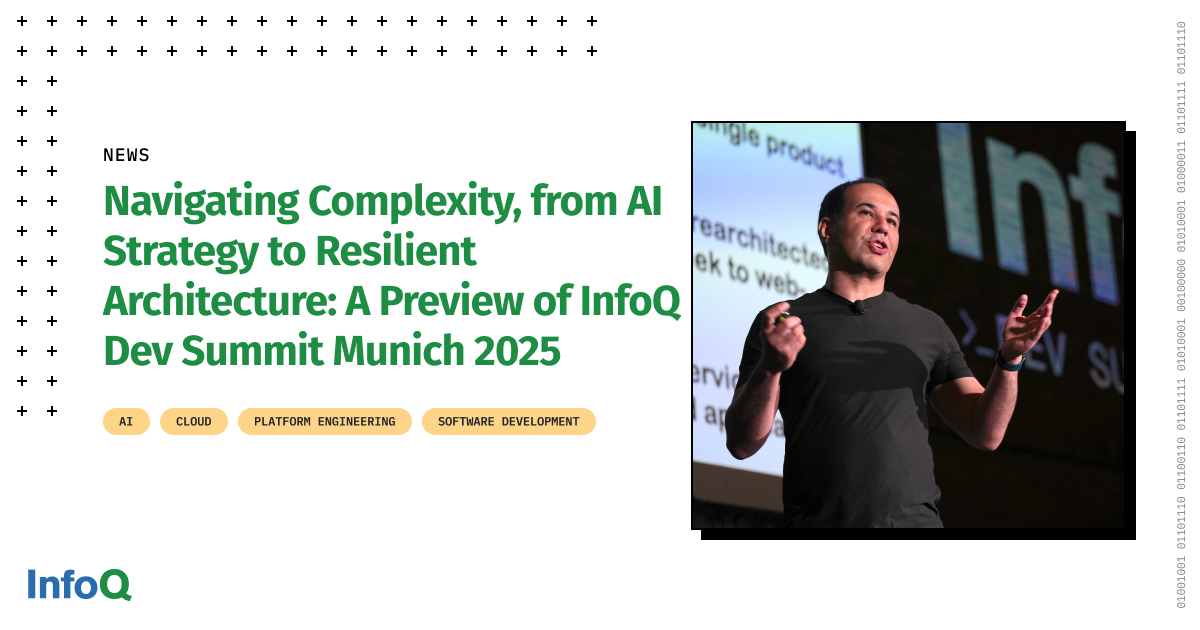
Here at InfoQ, we spend our days tracking the patterns and practices that senior software professionals are using to solve their toughest challenges. Currently, three key themes dominate our conversations with tech leaders across Europe: the immense pressure to integrate AI responsibly, the critical need to build secure and resilient systems, and the challenge of navigating an increasingly complex regulatory landscape.
At this year’s InfoQ Dev Summit Munich, taking place on 15–16 October, we’ll explore these pressures. We’ve curated a program that moves beyond the hype to focus on the peer-led, actionable insights you need to lead with confidence.
As always, we’ve built this conference on the core InfoQ principle: practical, unbiased content from practitioners in the trenches. No hidden product pitches. No marketing fluff. Just real-world lessons from the front lines of software development.
Here’s a preview of what we’re excited about so far:
Architecting for a Sovereign and Secure Europe
We know that data sovereignty and supply-chain security are top of mind for every architect in the EU. That’s why we’ve invited Markus Ostertag, Chief AWS Technologist at adesso, to give us a technical look at the forthcoming AWS European Sovereign Cloud.
We’ve also tasked Soroosh Khodami, Solution Architect at Code Nomads, with providing a hands-on checklist for hardening your CI/CD pipelines against the next big breach. These sessions are designed to give you the pragmatic strategies you need to build secure-by-design systems.
Moving from AI Hype to Real-World Impact
AI is reshaping our industry, but the real challenge lies in translating theory into tangible value. We’ve brought together speakers who are doing just that.
We’re excited for Patrick Debois to explore how AI is shifting the senior developer’s role from pure implementation to strategic intent. To ground this in reality, Mariia Bulycheva, Senior Applied Scientist at Zalando, will demonstrate how they are utilizing graph neural networks for large-scale personalization.
We’re kicking things off with a keynote from Katharine Jarmul on building privacy-first ML pipelines and closing with Tejas Kumar from DataStax, who will explore what’s next for Generative AI. This is about giving you the tools to lead your team’s AI adoption responsibly and effectively.
Building Resilient Systems Under Pressure
Finally, we aim to demonstrate what it truly takes to build resilient, high-performance systems. We’re particularly looking forward to hearing from Chris Tacey-Green, Head of Engineering at Investec. He won’t just show us the successful event-driven patterns behind their real-time payment system; he’s promised to share the scars and critical trade-offs they navigated on Azure.
Similarly, Daniele Frasca of Seven.One Entertainment Group will walk us through the architectural evolution required to meet the intense demands of a live TV streaming backend.
This is just a small sample of the talks. What excites us most is bringing these innovators together in one place. The summit is your opportunity to connect with peers, validate your own architectural thinking, and walk away with ideas you can implement immediately.
If you’re grappling with these challenges, we hope you’ll join us in Munich.
The InfoQ Dev Summit Munich takes place on 15-16 October 2025. Limited early bird tickets are available now.
MMS • Artenisa Chatziou
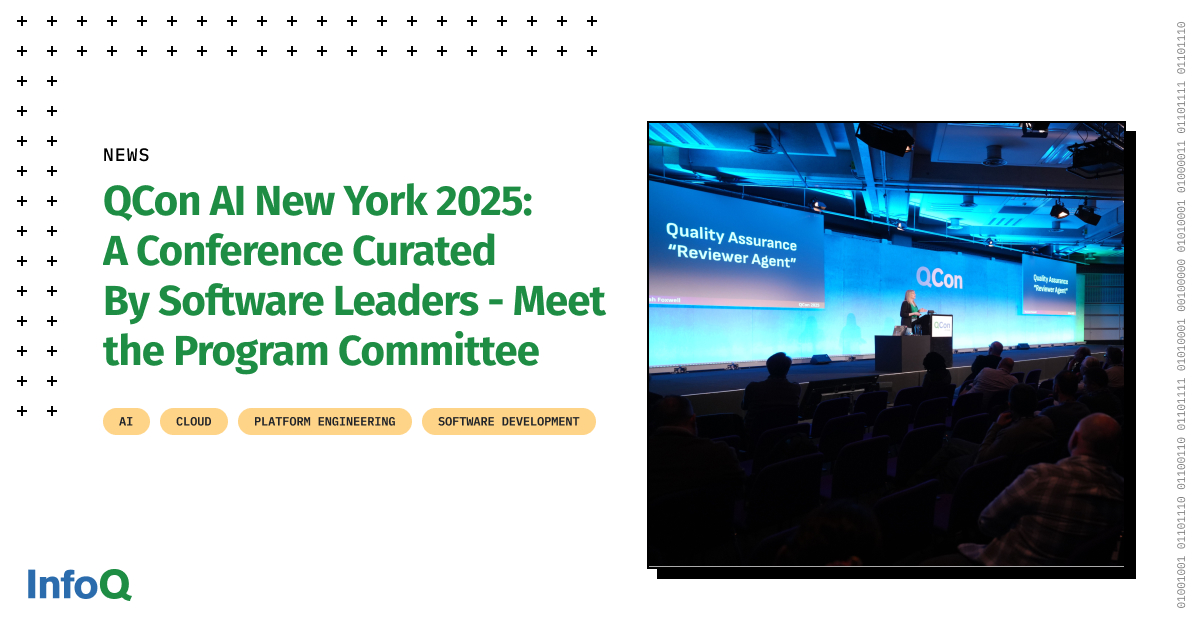
QCon AI New York (December 16-17, 2025), from the team behind InfoQ and QCon, has announced its Program Committee to shape talks focused on practical AI implementation for senior software engineering teams. The committee comprises senior practitioners with extensive experience in scaling AI in enterprise environments.
The 2025 Program Committee includes:
- Adi Polak – director of advocacy and developer experience engineering at Confluent, and author on scaling machine learning. Adi brings expertise in data-intensive AI applications and the infrastructure challenges of production ML systems.
- Randy Shoup – SVP of engineering at Thrive Market, with previous leadership roles at eBay, Google, and Stitch Fix. Shoup’s background in building scalable, resilient systems will inform content on enterprise-grade AI architecture.
- Jake Mannix – technical fellow for AI & relevance at Walmart Global Tech, with experience at LinkedIn and Twitter. Mannix contributes expertise in applying AI at scale within large enterprise contexts.
- Wes Reisz – QCon AI New York 2025 chair, technical principal at Equal Experts, and 16-time QCon chair.
QCon AI will focus on practical strategies for software engineers and teams looking to implement and scale artificial intelligence within enterprise environments.
Many teams are challenged by transitioning AI from promising proof-of-concepts (PoCs) to robust, value-driving production systems. QCon AI is specifically designed to help senior software engineers, architects, and team leaders navigate these issues and scale artificial intelligence within enterprise environments.
The conference program will feature practitioner-led strategies and case studies from companies successfully scaling AI, with sessions covering:
- Strategic AI integration using proven architectural patterns
- Building production-grade enterprise AI systems for scale and resilience
- Connecting Dev, MLOps, Platform, and Data practices to accelerate team velocity
- Navigating compliance, security, cost, and technical debt constraints in AI projects
- Using AI for design, validation, and strategic decision-making
- Showing clear business impact and return on investment from AI initiatives
“QCon AI is specifically designed to help software engineers navigate these issues in AI adoption and integration, focusing on the applied use of AI in delivering software to production.”
Reisz explained.
“The goal is to help teams not only embrace these changes but ship better software.”
Early bird registration is available. Book your seat now.
Announcing QCon AI: Focusing on Practical, Scalable AI Implementation for Engineering Teams
MMS • Artenisa Chatziou
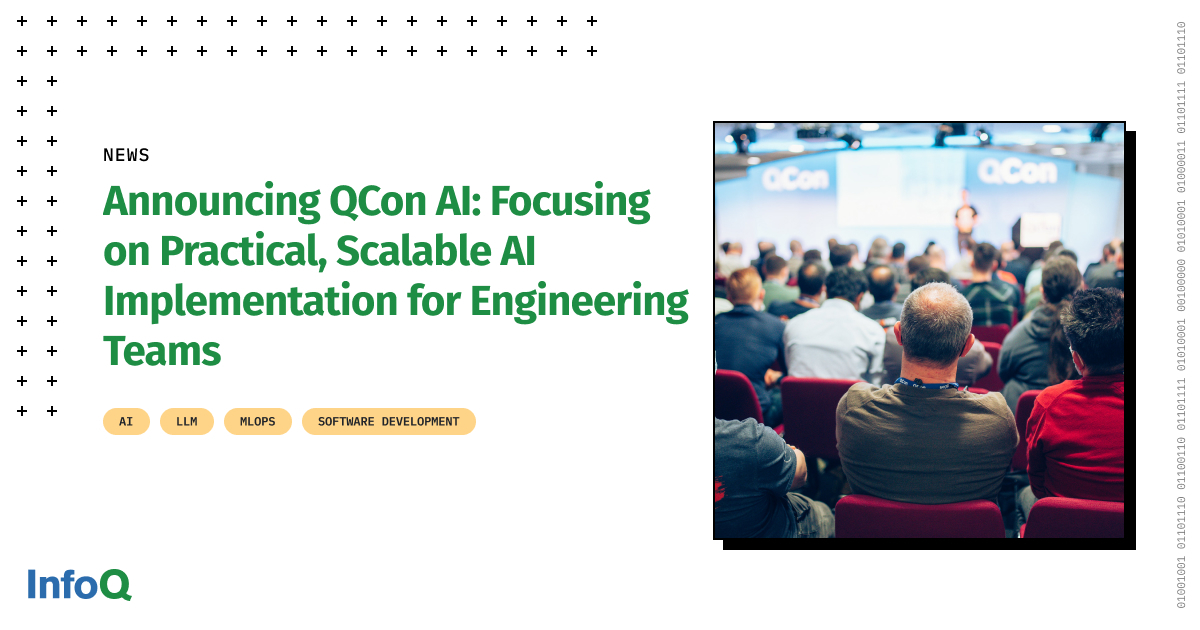
QCon conferences have been a trusted forum for senior software practitioners to share real-world knowledge and navigate technology shifts for nearly two decades. Today, as artificial intelligence adoption transitions from experimental phases to running within critical enterprise systems, InfoQ and QCon are introducing QCon AI, a new conference dedicated to the practical challenges of building, deploying, and scaling AI reliably. The inaugural event will take place in New York City on December 16-17, 2025.
This conference is designed specifically for senior software developers, architects, and engineering leaders – the practitioners tasked with making AI work securely, reliably, and effectively within complex enterprise environments. Recognizing that the landscape is filled with hype, QCon AI focuses squarely on what’s working now. The program, curated by senior engineers actively running AI systems at scale, prioritizes actionable patterns and blueprints over theoretical possibilities.
QCon AI builds directly on the QCon legacy of facilitating peer-to-peer learning without hidden product pitches. As QCon AI 2025 Conference Chair, Wes Reisz, Technical Principal @ Equal Experts, ex-VMWare, ex-ThoughtWorks,16-time QCon Chair, and InfoQ Podcast Co-host emphasizes.
“Forget the AI hype. QCon AI is focused on helping you build and scale AI reliably. The teams speaking at QCon AI share how they are delivering and scaling AI – warts and all”.
Attendees can expect deep dives into the practicalities of integrating AI into the software development lifecycle, architecting resilient and observable production AI systems, managing MLOps, optimizing costs, ensuring responsible governance, and proving business value. We believe it’s crucial to share hard-won lessons – including failures – from those who have navigated these challenges.
A key theme for QCon AI is the collaborative nature of successful AI implementation. Scaling AI isn’t a solo task; it requires alignment across multiple departments, including development, MLOps, platform, infrastructure, and data teams. QCon AI is structured to benefit teams attending together. Shared learning experiences can accelerate the adoption of effective patterns, foster better cross-functional understanding, reduce integration risks, and help align team members, from Staff+ engineers and architects to ML engineers and engineering leaders, on strategy and execution.
By bringing together experienced practitioners to share what truly works in enterprise AI, QCon AI aims to equip engineering teams with the confidence and knowledge needed to move from prototype to production successfully.
More information about QCon AI, including program details as they become available, can be found on the conference website.
MMS • Artenisa Chatziou
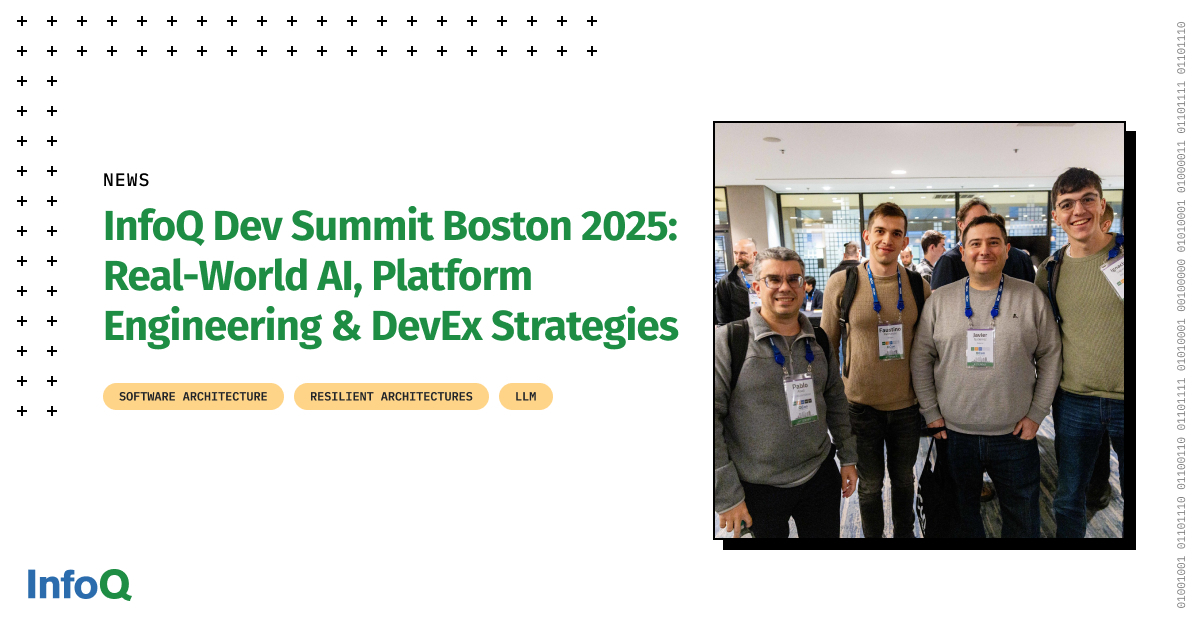
InfoQ Dev Summit Boston 2025 (June 9-10, 2025) is where senior software developers, architects, and engineering leaders come together to tackle today’s most pressing challenges in AI adoption, platform engineering, and developer experience (DevEx). With a focus on topics that will be important over the next 18 months, this event from the team behind InfoQ and QCon delivers insights from practitioners building and scaling modern software systems so your team can execute with confidence.
“If you’re a senior developer, architect, or team lead, you know the landscape is evolving fast. So, where do you turn for actionable insights and not just buzzwords? InfoQ Dev Summit Boston on June 9-10: This event is different – no hidden product pitches, no fluff, just deep technical talks from practitioners who are building and scaling real systems. If you want to stay ahead, learn from your peers, and bring back concrete strategies to your team, this is where you need to be”.
—Eder Ignatowicz, InfoQ Dev Summit Boston 2025 Chair, senior principal software engineer & architect @RedHat.
More Than Just Talks: a High-Impact Learning & Networking Experience
At InfoQ Dev Summit Boston, the real value extends beyond the sessions. It’s about direct access to leading engineers, exchanging lessons with peers who’ve faced similar challenges, and engaging in meaningful discussions that don’t happen online. Whether it’s deep-dive speaker Q&As, spontaneous hallway conversations, or focused breakout discussions, attendees leave with practical knowledge and professional connections that drive impact long after the event.
If you’re looking for a space to go beyond surface-level discussions and engage with a community of senior engineers solving real-world software challenges, this is the summit to attend.
Seven Talks You Can’t Miss
1. Scaling AI in the Real World: Patterns That Actually Work – Phil Calçado, founder & CEO @Outropy, with 20+ years experience in software development, previously pioneered microservices architecture @SoundCloud, and scaled systems @DigitalOcean & @SeatGeek
Calçado shares hard-won lessons from scaling an AI assistant from prototype to 10,000 users, outperforming bigger players like Salesforce and Slack AI. This talk reveals what traditional patterns still work for AI systems – and which ones break under the pressure of stateful, stochastic architectures. Walk away with architectural insights that are immediately useful for teams shipping real AI products.
2. Empathy Driven Platforms: You Build it, Let’s Run it Together – Erin Doyle, founding engineer @Quotient and instructor @Egghead | 20+ years across full stack development in web and mobile, and platform engineering
The promise of DevOps—”you build it, you run it”— was meant to streamline ownership. However, as systems grow more complex, developers are increasingly burdened with operational overhead that impacts productivity and morale. In this talk, Doyle shares how platform teams can reduce this burden by building with empathy, prioritizing psychological safety, intuitive tooling, and collaborative design. Learn practical ways to create self-service platforms that developers actually want to use while supporting their growth and autonomy.
3. Theme Systems at Scale: How to Build Highly Customizable Software – Guilherme Carreiro, staff engineer @Shopify, championing the evolution of Liquid, with 14+ years in software development, previously led DMN tooling team @Red Hat
Liquid themes power thousands of Shopify storefronts with both speed and flexibility. Carreiro shares how to build secure, human-friendly DSLs, support visual editors for non-technical users, and enhance developer tooling via VS Code and language servers. If you’re building platforms for diverse users, this talk offers battle-tested lessons for scalable, customizable architecture.
4. Systems Thinking for Scaling Responsible Multi-Agent Architectures – Nimisha Asthagiri, principal data & AI @Thoughtworks, previously chief architect @edX
As multi-agent systems become core to enterprise AI, scaling them responsibly is critical. Asthagiri shares patterns for building modular, self-regulating agent networks and introduces oversight techniques to prevent unintended behaviors. With system-wide feedback loops and governance baked into design, attendees will leave better equipped to scale AI systems ethically and efficiently.
5. Thinking Like a Detective: Solving Cloud Infrastructure Mysteries – Brendan McLoughlin, frontend architect @CarGurus, former ember data maintainer, and previously open web consultant @Bocoup
When cloud services fail silently, debugging requires more than just code knowledge. McLoughlin takes a detective’s approach to cloud troubleshooting, showing how to investigate CDNs, WAFs, load balancers, and more. Attendees will gain practical techniques for mapping request paths, building better runbooks, and interpreting subtle failure clues to solve complex infrastructure issues.
6. AI-Enabled Delivery: Leveraging ChOP & LLMs for Learning and Certification – Wes Reisz, technical principal @Equal Experts, ex-Thoughtworker & ex-VMWare, 16-time QCon chair, and creator/co-host of “The InfoQ Podcast”
How do you build a meaningful, AI-powered certification experience from conference content? Reisz shares how he and the InfoQ/QCon team combined Chat-Oriented Programming (ChOP), Retrieval-Augmented Generation (RAG), and expert intuition to create the InfoQ Certified Architect in Emerging Technologies program. This session explores real-world patterns for integrating LLMs with human guidance, lessons from prompt engineering, and how to design systems that go beyond automation to enhance human learning.
7. Building an Internal Developer Portal That Empowers Developers – Travis Gosselin, Distinguished Engineer of Developer Experience @SPS Commerce, with 20+ years of experience
Internal Developer Portals promise better productivity, but successfully implementing one requires more than just tools. Gosselin walks through SPS Commerce’s approach to building a developer portal with real impact – from making a compelling business case to driving adoption and measuring outcomes. Whether starting from scratch or iterating on an existing platform, you’ll leave with actionable guidance for creating a developer portal that truly empowers your team.
Why These Topics Matter Now
Engineering teams are under pressure to scale AI responsibly, optimize platform engineering, and improve developer experience while maintaining velocity. InfoQ Dev Summit Boston focuses on execution over hype, ensuring you leave with:
- Field-tested solutions: Talks from engineers actively solving these challenges in production environments.
- Peer-driven insights: Direct conversations with practitioners who’ve faced the same problems you’re tackling.
- Actionable takeaways: Practical strategies your team can apply immediately.
- A high-value network: Meaningful connections with senior developers, architects, and technical decision-makers.
If you want to stay ahead of the curve and bring tangible insights back to your team, this is the event to attend! Early bird pricing ends April 15, 2025. Register now to save your seat.
Our next summit is InfoQ Dev Summit Munich 2025, which returns October 15-16, 2025, with more practitioner-led insights on tackling today’s critical software development challenges.
Build Resilient Systems with Insights on AI, Multi-Cloud, Leadership & Security at QCon London 2025
MMS • Artenisa Chatziou
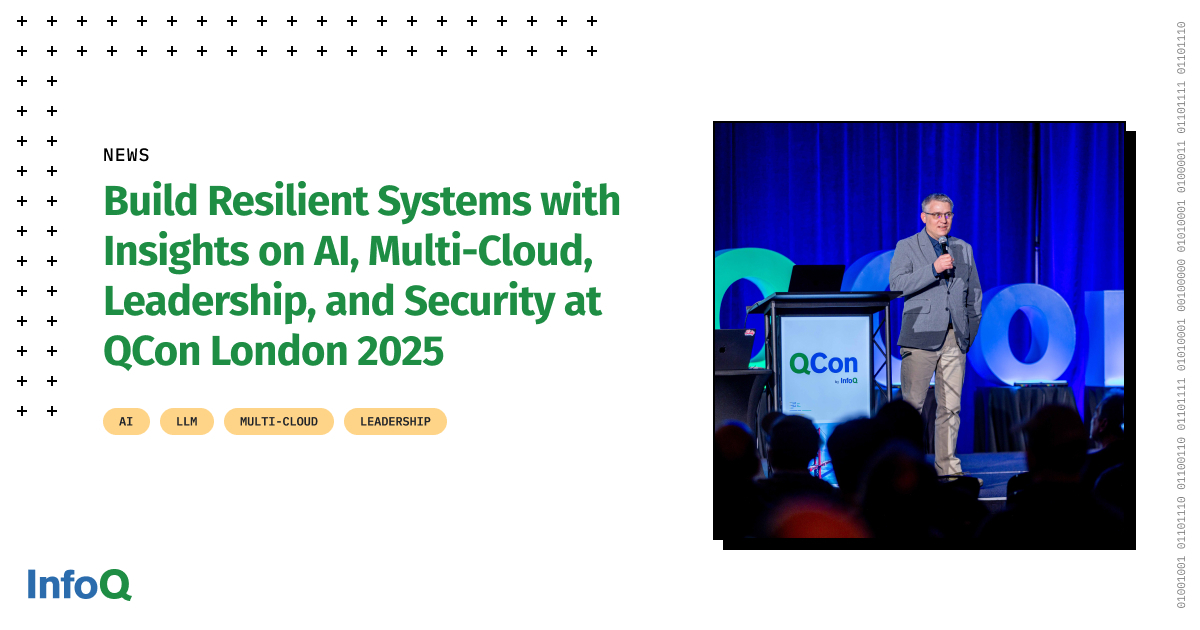
QCon London returns on April 7-11, 2025, bringing together 125+ senior software practitioners to share actionable insights across 15 practitioner-curated tracks focusing on emerging trends in software development.
Designed for senior software engineers, architects, and team leads, QCon will help you adopt the right technologies and practices. Discover how senior software practitioners are tackling modern challenges, from scaling architectures and enhancing developer productivity to securing supply chains and navigating AI integration.
Top Tracks at QCon London 2025: Architecture, Staff+, AI, and More
Architectures You’ve Always Wondered About
This track explores real-world examples of innovative companies pushing the limits with modern software systems. Speakers will share their stories of scaling their systems to handle large amounts of traffic, data, and complexity. QCon London 2025 Track Host: Ian Thomas, software engineer @Meta, with a background in Computer Science with a detour into UX and design, and QCon London 2024 PC Chair.
The Path to Senior Engineering Leadership
What does it take to reach senior leadership in tech? Gain insights into the journey toward senior engineering leadership, including strategies for managing teams, driving technical decisions, and fostering growth. QCon London 2025 Track Host: Leandro Guimarães, senior engineering manager @ClassPass, former chair of QCon in Brazil, working in software development for over 24 years.
AI and ML for Software Engineers: Foundational Insights
Deep dive into the foundational concepts of AI and ML and discover practical ways to integrate these technologies into software development. QCon London 2025 Track Host: Hien Luu, senior engineering manager @Zoox, leading the Machine Learning Platform team, & author of MLOps with Ray.
Engineering Productivity and Developer Experience
Learn how to enhance engineering productivity and create developer experiences that empower teams to deliver high-quality software efficiently. QCon London 2025 Track Host: Blanca Rojo, distinguished engineer and executive director at UBS, specializing in cloud engineering, and AI champion.
Modern Data Architectures
In this track, software leaders will share the actionable insights, cutting-edge strategies, and real-world case studies you need to navigate this evolving landscape. QCon London 2025 Track Host: Fabiane Nardon, data expert, Java Champion by Sun Microsystems & data platform director @totvs, Brazil’s largest tech company.
Connecting Systems: APIs, Protocols, Observability
Explore best practices for designing APIs, implementing protocols, and achieving observability in distributed systems. QCon London 2025 Track Host: Daniel Bryant, platform engineer, co-author of “Mastering API Architecture”, Java Champion, and InfoQ news manager.
Health Tech
Discover how technology is transforming healthcare with insights on optimizing patient outcomes, resilience, and innovations at the intersection of health and technology. QCon London 2025 Track Host: Dr. Jack Kreindler, founder and CEO @Wellfounded Health, chair of Leaders in Health, Extreme Environments Physiologist, & Medical Technology Entrepreneur, Researching the Limits of Human Resilience & Technology for Optimizing Health & Patient Outcomes.
Resilient Engineering Practices for Security against Modern Threats
Learn how to secure your software supply chain by embedding proactive strategies into your workflows to tackle modern vulnerabilities.QCon London 2025 Track Host: Sonya Moisset, staff security advocate @Snyk, a mentor for women in tech, a cybersecurity writer for FreeCodeCamp publications, 4x GitHub Stars, and an active member of the tech community in the UK.
Multi-Cloud and Hybrid Cloud Architectures
In this track, speakers will share real-world examples of multi-cloud adoption, focusing on integration, security, automation, orchestration, and analytics to optimize performance and cost-efficiency. QCon London 2025 Track Host: Dio Rettori, multi-cloud strategy and product @JPMorgan Chase & Co, ambassador for Cloud Native Computing Foundation, advisor for InfinyOn Inc., previously @Solo.io, @Red Hat, and @ Pivotal Software.
Emerging Trends in the Frontend and Mobile
This track will explore cutting-edge trends and best practices for building high-performance, responsive, and engaging frontend and mobile applications that meet the evolving needs of modern users. QCon London 2025 Track Host: Sareh Heidari, senior software engineer at F1 Arcade®, the intersection of Formula 1® racing simulations in a hospitality setting.
Presented by InfoQ, QCon London 2025 shares talks you can trust, free from vendor bias and marketing agendas. Attendees gain actionable insights from real-world experiences shared by practitioners adopting emerging trends and practices.
For more details, visit QCon London 2025. Early bird pricing ends on February 11, 2025.
MMS • Artenisa Chatziou
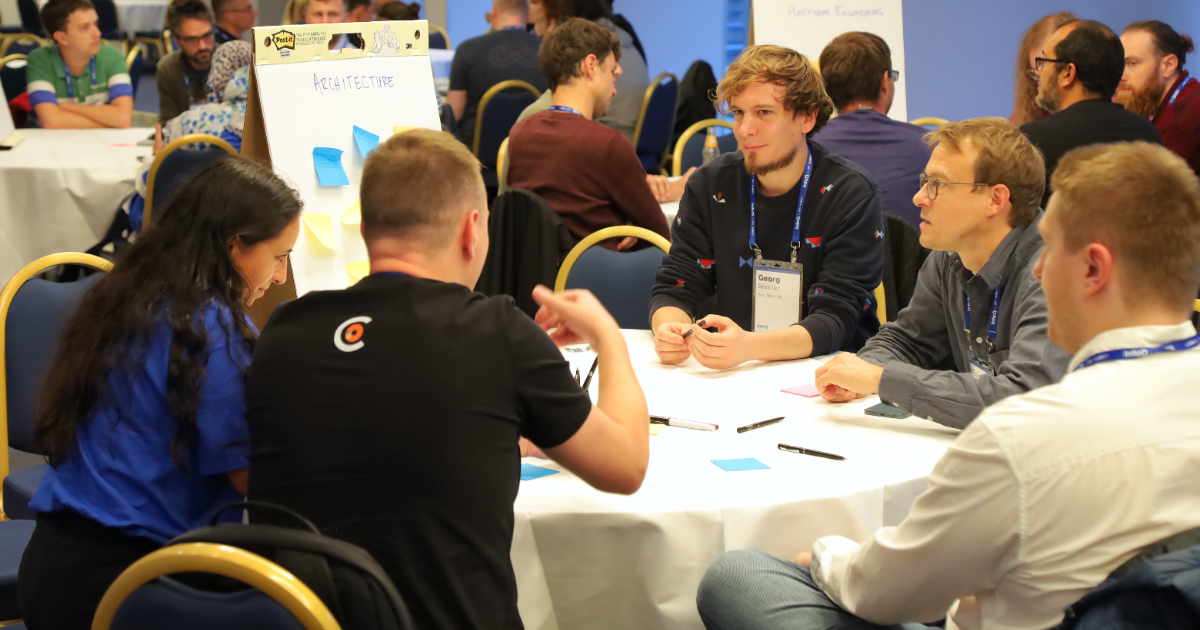
Returning for its 19th year, QCon London 2025 offers more than just three days of technical sessions (April 7–9). Attendees can also take advantage of two optional training days (April 10–11), designed to provide hands-on, in-depth learning experiences for senior developers, architects, and team leads. These sessions are an excellent opportunity to dive deep into critical software development topics and refine skills with guidance from senior practitioners.
Exclusive conference and training offer: For a limited time, register for a QCon London 2025 conference pass with one or two days of training and save 20% on training day passes. Use PROMO20TrainingQUK25 at checkout. Offer valid until Wednesday, January 29, 2025.
Training Topics Announced
The QCon training lineup includes one-day and two-day sessions covering a variety of crucial topics in software development. Each session is led by experienced practitioners, ensuring a high-quality learning experience. Highlights include:
- Success Patterns for Fast Flow and Team Topologies: Discover success patterns for fast flow and Team Topologies with insights from Conflux’s award-winning transformations. Training led by Matthew Skelton, CEO @Conflux, and Val Yonchev, head of customer success @Team Topologies.
- Developing Secure and Robust Enterprise Java Applications with Jakarta EE: Learn to create a secure Java app with Jakarta EE 11, exploring key specifications using Payara Micro. Training led by Michael Redlich, Java Champion, founder @Garden State Java User Group, editor @InfoQ.
- From Kubernetes-Native to Ai-Powered: Java with Langchain4j: Learn to build high-performance, AI-powered Java applications in a Kubernetes-native world with Langchain4j. Training led by Elder Moraes, principal developer advocate @Red Hat.
- AWS Kubernetes Security for Developers: Discover the fundamentals of Kubernetes, Amazon EKS, and container security with hands-on labs for deploying and securing applications. Training led by Ashish Rajan, CISO @Kaizenteq Ltd, host of “Cloud Security Podcast” and SANS trainer for cloud security, 13+ years experience in the CyberSecurity industry.
- Dealing with Challenging People and Situations – Concrete Skills to Overcome the Awkward and Increase Connection: Learn practical communication skills to navigate challenging situations, set boundaries, and build connections with confidence and ease. Training led by Charlotte de Jong Schouwenburg, co-founder of @Bravely, business psychologist, executive coach, trainer, and speaker with 12+ years of experience enabling high-performing teams and leaders.
- Microservice Bootcamp, a Practical View on Benefits, Costs and Challenges: Get practical insights into microservice architecture, covering its benefits, challenges, and impact on team structure, business alignment, and DevOps practices. Training led by Andreas Kleinbichler, head of engineering portal @Admiral Sportwetten.
- Hands-on AI for Vision: from Diffusion to Production: Master advanced image generation, computer vision techniques, and scalable deployment strategies to integrate cutting-edge Vision AI solutions into real-world applications. Training led by Iaroslav Amerkhanov, senior data scientist @Delivery Hero.
- Using LLMs beyond Chatting: Learn to simplify business problems for LLMs, deliver solutions quickly, and apply prompt engineering, structured outputs, and private deployment with open-source tools. Training led by Jendrik Jördening, chief technology officer @Nooxit.
- Additional sessions cover topics like cloud security, platform engineering, and building modern financial applications. Explore all training sessions.
Flexible training refund policy: to accommodate changing plans, QCon offers a full refund of the training portion of your ticket if you cancel by February 24, 2025 – no questions asked.
Why Attend QCon London?
QCon is specifically tailored for senior developers and architects in enterprise environments, with a focus on delivering practical insights and actionable strategies. From cutting-edge tools to proven patterns, the event is designed to help attendees align on priorities and drive their teams forward.
Need help convincing your boss? Use our templates. Simply edit as needed.
Software Architecture Tracks at QCon San Francisco 2024 – Navigating Current Challenges and Trends
MMS • Artenisa Chatziou
At QCon San Francisco 2024, software architecture is front and center, with two tracks dedicated to exploring some of the largest and most complex architectures today. Join senior software practitioners as they provide inspiration and practical lessons for architects seeking to tackle issues at a massive scale, from designing diverse ML systems at Netflix to handling millions of completion requests within GitHub Copilot.
QCon focuses on lessons learned by senior software practitioners pushing the boundaries in today’s environment. Each talk provides real-world insights, with speakers exploring not just technical success but also the challenges, pivots, and innovative problem-solving techniques needed to achieve this.
The first track, “Architectures You’ve Always Wondered About“, brings together leading engineers from companies like Netflix, Uber, Slack, GitHub, and more who will share their real-world experiences scaling systems to handle massive traffic, data, and functionality. Talks include:
- Supporting Diverse ML Systems at Netflix: David Berg, Senior Software Engineer @Netflix, and Romain Cledat, Senior Software Engineer @Netflix, share how Netflix leverages its open-source platform, Metaflow, to empower ML practitioners across diverse business applications.
- Optimizing Search at Uber Eats: Janani Narayanan, Applied ML Engineer @Uber, and Karthik Ramasamy, Senior Staff Software Engineer @Uber, share how Uber Eats optimizes search with its in-house engine, with insights into scaling for high-demand, optimizing latency by 40%, and building cost-effective, high-performance search solutions in a cloud-centric world.
- Cutting the Knot: Why and How We Re-Architected Slack: Ian Hoffman, Staff Software Engineer @Slack, Previously @Chairish, explores Slack’s Unified Grid project, a re-architecture enabling users to view content across multiple workspaces in a single view and shares the technical challenges, design decisions, and lessons learned to improve performance and streamline workflows.
- How GitHub Copilot Serves 400 Million Completion Requests a Day: David Cheney, Lead, Copilot Proxy @GitHub, Open Source Contributor and Project Member for Go Programming Language, Previously @VMware, shares insights into the architecture that powers GitHub Copilot, detailing how it manages hundreds of millions of daily requests with response times under 200ms.
- Legacy Modernization: Architecting Real-Time Systems Around a Mainframe: Jason Roberts, Lead Software Consultant @Thoughtworks, 15+ years in Software Development, and Sonia Mathew, Director, Product Engineering @National Grid, 20+ Years in Tech, share how National Grid modernized their mainframe-based system by creating an event-driven architecture with change data capture, powering a scalable, cloud-native GraphQL API in Azure.
The second track, “Architectural Evolution“, explores key architectural trends, from monoliths to multi-cloud to event-driven serverless, with insights from practitioners on the criteria and lessons learned from running these models at scale. Talks include:
- Thinking Like an Architect: Gregor Hohpe, CxO Advisor, Author of “The Software Architect Elevator”, Member of IEEE Software Advisory Board, Previously @AWS, @Google, and @Allianz, shares how architects empower their team by sharing decision models, identifying blind spots, and communicating across organizational layers to achieve impactful, aligned results.
- One Network: Cloud-Agnostic Service and Policy-Oriented Network Architecture: Anna Berenberg, Engineering Fellow, Foundation Services, Service Networking, @Google Cloud, Co-Author of “Deployment Archetypes for Cloud Applications”, shares how Google Cloud’s One Network unifies service networking with open-source proxies, uniform policies, and secure-by-default deployments for interoperability and feature parity across environments.
- Renovate to Innovate: Fundamentals of Transforming Legacy Architecture: Based on experience scaling payment orchestration at Netflix, Rashmi Venugopal, Product Engineering @Netflix, Previously Product Engineer @Uber & @Microsoft, shares cognitive frameworks for assessing architectural health, overcoming legacy transformation challenges, and strategies for a successful software overhaul.
- Slack’s Migration to a Cellular Architecture: Cooper Bethea, Formerly Senior Staff Engineer and Technical Lead @Slack, Previously SRE Lead and SRE Workbook Author @Google, explores Slack’s shift to a cellular architecture to enhance resilience and limit cascading failures, following a critical incident.
The conference offers a unique opportunity for software architects and engineers to engage directly with active practitioners, gain actionable insights, and explore strategies for tackling today’s biggest architectural challenges.
There are just a few weeks left to secure your spot and explore how these architectural innovations can drive your organization forward. Don’t miss out on QCon San Francisco this November 18-22!
AI and ML Tracks at QCon San Francisco 2024 – a Deep Dive into GenAI & Practical Applications
MMS • Artenisa Chatziou

At QCon San Francisco 2024, the international software development conference by InfoQ, there are two tracks dedicated to the rapid advancements in AI and ML, reflecting how these technologies have become central to modern software development.
The conference spotlights senior software developers from enterprise organizations, sharing their approaches to adopting emerging trends. Each session provides actionable insights and strategies attendees can immediately apply to their own projects. Each talk is led by seasoned practitioners who share actionable knowledge—no marketing pitches, just real-world solutions.
The first track, Generative AI in Production and Advancements, curated by Hien Luu, Sr. engineering manager @Zoox & author of MLOps with Ray, provides a deep dive into practical AI/ML applications and the latest industry innovations. The track explores real-world implementations of GenAI, focusing on how companies leverage it to enhance products and customer experiences.
Talks will include insights from companies like Pinterest, Meta, Microsoft, Voiceflow, and more, sharing best practices on deploying large language models (LLMs) for search and recommendations and exploring AI agents’ potential for the future of software:
- Scaling Large Language Model Serving Infrastructure at Meta: Charlotte Qi, senior staff engineer @Meta, will share insights on balancing model quality, latency, reliability, and cost, supported by real-world case studies from their production environments.
- GenAI for Productivity: Mandy Gu, senior software development manager @Wealthsimple, will share how they use Generative AI to boost operational efficiency and streamline daily tasks, blending in-house tools with third-party solutions.
- Navigating LLM Deployment: Tips, Tricks, and Techniques: Meryem Arik, co-founder @TitanML, recognized as a technology leader in Forbes 30 Under 30, will cover best practices for optimizing, deploying, and monitoring LLMs, with practical tips and real case studies on overcoming the challenges of self-hosting versus using API-based models.
- LLM Powered Search Recommendations and Growth Strategy: Faye Zhang, staff software engineer @Pinterest, covers model architecture, data collection strategies, and techniques for ensuring relevance and accuracy in recommendations, with a case study from Pinterest showcasing how LLMs can drive user activation, conversion, and retention across the marketing funnel.
- 10 Reasons Your Multi-Agent Workflows Fail and What You Can Do about It: Victor Dibia, principal research software engineer @Microsoft Research, core contributor to AutoGen, author of “Multi-Agent Systems with AutoGen” book, will share key challenges in transitioning from experimentation to production-ready systems and highlight 10 common reasons why multi-agent systems often fail.
- A Framework for Building Micro Metrics for LLM System Evaluation: Denys Linkov, head of ML @Voiceflow, LinkedIn Learning Instructor, ML advisor, and instructor, explores how to measure and improve LLM accuracy using multidimensional metrics beyond a simple accuracy score.
The second track, “AI and ML for Software Engineers: Foundational Insights“, curated by Susan Shu Chang, principal data scientist @Elastic, author of “Machine Learning Interviews”, is tailored to those looking to integrate AI/ML into their work.
The talks will cover the deployment and evaluation of ML models, providing hands-on lessons from companies that have faced similar challenges:
- Recommender and Search Ranking Systems in Large Scale Real World Applications: Moumita Bhattacharya, senior research scientist @Netflix, dives into the evolution of search and recommendation systems, from traditional models to advanced deep learning techniques.
- Why Most Machine Learning Projects Fail to Reach Production and How to Beat the Odds: Wenjie Zi, senior machine learning engineer and tech lead @Grammarly, specializing in natural language processing, 10+ years of industrial experience in artificial intelligence applications, will explore why many machine learning projects fail, despite the growing hype around AI, and how to avoid common pitfalls such as misaligned objectives, skill gaps, and the inherent uncertainty of ML.
- Verifiable and Navigable LLMs with Knowledge Graphs: Leann Chen, AI developer advocate @Diffbot, creator of AI and knowledge graph content on YouTube, will demonstrate how knowledge graphs enhance factual accuracy in responses and how their relationship-driven features enable LLM-based systems to generate more contextually-aware outputs.
- Reinforcement Learning for User Retention in Large-Scale Recommendation Systems: Saurabh Gupta, senior engineering leader @Meta, and Gaurav Chakravorty, Uber TL @Meta, will share insights into leveraging reinforcement learning (RL) for personalized content delivery, exploring reward shaping, optimal time horizons, and necessary infrastructure investments for success at scale.
- No More Spray and Pray— Let’s Talk about LLM Evaluations: Apoorva Joshi, senior AI developer @MongoDB, six years of experience as a data scientist in cybersecurity, active member of Girls Who Code, Women in Cybersecurity (WiCyS) and AnitaB.org, will share practical frameworks for LLM evaluation that someone can apply directly to their projects.
These sessions aim to bridge the gap between AI hype and practical, scalable applications, helping engineers of all levels navigate the evolving AI landscape.
Explore all 12 tracks taking place at QCon San Francisco this November 18-22, and take advantage of the last early bird tickets ending on October 29. With only a few weeks left, join over 1,000 of your peers in shaping the future of software development!
Modern Data Architecture, ML, and Resilience Topics Announced for QCon San Francisco 2024
MMS • Artenisa Chatziou
QCon San Francisco returns November 18-22, focusing on innovations and emerging trends you should pay attention to in 2024. With technical talks from international software practitioners, QCon will provide actionable insights and skills you can take back to your teams.
The QCon San Francisco 2024 Program Committee has met and finalized the 2024 tracks (conference topics). The 12 tracks include:
- Generative AI in Production & Advancements: This track dives into the latest advancements, exploring how to translate groundbreaking research into real-world applications across various industries.
- Architectures You’ve Always Wondered About: This track will explore real-world examples of innovative companies pushing the limits with modern software systems.
- Modern Data Architectures: This track showcases how innovators are finding new ways to store, analyze, and scale data components.
- Hardware Architectures You Need To Know: This track explores how hardware has moved significantly in different directions to serve the needs of our ever-complex service with Machine Learning, Networking, Graphics Processing, and more.
- Programming Languages and Paradigms for the Next Decade: This track offers a deep dive into innovative programming languages, language features, cutting-edge programming models, and paradigm shifts that aid in making code more efficient, safe, and maintainable.
- Sociotechnical Resilience: Explore how artificial intelligence is reshaping traditional leadership models and the skills required for engineering leaders to effectively guide teams in the age of AI.
- Getting Started in Machine Learning: This track gets to grips with the theoretical and practical considerations in ML and understands the tools and platforms that make up the discipline.
- Explore all tracks.
Learn modern practices to evolve your skills with QCon training days
As in previous years, QCon San Francisco offers two additional days of training days for senior developers/leaders following the main conference. This year, QCon features 12 training sessions on November 21-22, covering topics such as:
- A Practitioner’s View on Implementing Team Topologies
- Soft Skills for Tomorrow’s Technical Leaders
- AI/ML Mastery: From Theory to Implementation
- AI Engineering: Building Generative AI Apps
- Mastering Serverless
- Microservices Bootcamp
- Architecting Scalable APIs
- Applied Domain-Driven Design
- Mastering Cloud, K8s, and DevOps
- Building Modern Data Analytics
- Securing Modern Software
- Building Scalable Java Applications
Don’t miss out on practical, hands-on learning with software domain experts at QCon San Francisco. Add Training Days to your conference pass, or get a training-only pass. If you change your mind, QCon’s Training Refund Guarantee Policy offers a no-questions-asked refund up to September 23, 2024.
Why Attend QCon San Francisco?
- Walk away with actionable insights: Learn how your peers are solving similar complex challenges right now.
- Level-up with senior software leaders: Learn what’s next from world-class leaders pushing the boundaries.
- No hype. No hidden marketing. No sales pitches: At QCon, there are no product pitches or hidden marketing. Your time is focused on learning, exploring, and researching, not being sold to.
- Save valuable time without wasting resources: Get the assurance you are adopting the right technologies and skills.
Join QCon San Francisco this Nov 18-22, and take advantage of the last early bird tickets. Don’t miss the chance to learn from software leaders at early adopter companies.
LLM Strategies, Platform Engineering, Observability and More: InfoQ Dev Summit Boston 2024
MMS • Artenisa Chatziou
The software development landscape evolves rapidly, and staying ahead requires continuous learning to inform strategic decision-making, implement new technologies appropriately, and enable your teams to collaborate effectively. Join us at InfoQ Dev Summit Boston, running June 24-25, to network with your peers and experience a curated agenda with topics such as Generative AI, security, and modern web applications. You’ll learn from those who have successfully implemented these technologies and navigated related challenges to help you be successful with your projects.
The conference will feature 20+ technical talks by senior software practitioners over two days, with parallel breakout sessions emphasizing the essential topics development teams should prioritize now. Talk highlights include:
How to Take a Large Language Model from a Data Scientist and Put It in Production
Francesca Lazzeri, principal data scientist manager @Microsoft, author of “Machine Learning for Time Series Forecasting with Python”, will share practical advice on successful LLM deployment in various domains and settings, lessons learned, and best practices such as:
- Choosing the right model for the task based on the model’s size, complexity, and domain.
- Optimizing the model using prompt engineering, fine-tuning, and context retrieval techniques to improve accuracy and relevance.
- Deploying the model using scalable and secure infrastructure, such as cloud platforms or vector databases, to handle variable workloads and latency.
- Monitoring the model performance and user feedback, using metrics and tools such as MLOps and Responsible AI Framework, to identify and address any issues or risks.
- Iterating the model based on the changing needs and expectations of the users and the domain, using continuous integration and deployment strategies.
OpenTelemetry, Opening the Door to Observability for All
How do I start with OpenTelemetry? How can I automatically instrument my application? How do I use the OpenTelemetry Collector? Ken Finnigan, OpenTelemetry architect @Lumigo, author of “Reactive Systems in Java,” will answer these and many more questions. While detailing the ins and outs of application instrumentation and collection with OpenTelemetry, Finnigan explores critical challenges to the success of Observability at an enterprise.
Best Practices for Building Secure Web Applications
In this presentation, Loiane Groner, development manager @Citibank, will delve into the essential neglected aspects of securing your applications. Groner will cover best practices for secure coding, meticulous input validation techniques, the importance of strategic error handling and logging, how to manage file uploads safely, and much more.
Blueprints of Innovation: Engineering Paved Paths for a User-friendly Developer Platform at The New York Times
In this talk, David Grizzanti, principal engineer @nytimes, will provide valuable insights into the nuances of platform engineering in the cloud, offering attendees a blueprint for implementing similar strategies in their organizations. Discover challenges faced while building a multi-tenant platform in the cloud, including specifics on how the New York Times designed:
- A simple onboarding experience, complete with starter software templates
- A secure and isolated environment on top of our centralized Kubernetes clusters
- A simple onboarding experience for multiple cloud accounts for each tenant
- A centralized approach to CI/CD, including standard build and test pipelines
Build better-connected teams in Boston
Attending InfoQ Dev Summit Boston as a team empowers collaborative learning, leading to informed project decisions and clarity for your dev roadmap. Teams as small as three attendees working for the same company are eligible for a group discount. For more details, email info@devsummit.infoq.com and mention the size of the group. Early bird savings and team discounts are available until April 16.
Team discounts for InfoQ Dev Summit Boston:
- 3-6 attendees – save up to $35 off each conference ticket
- 7-10 attendees – save up to $55 off each conference ticket
- 11-15 attendees – save up to $65 off each conference ticket
- 16+ attendees – save up to $75 off each conference ticket
Why attend InfoQ Dev Summit Boston as a team?
- Practitioner-curated talks handpicked by senior developers to focus on the critical technical challenges your team faces.
- Learn actionable insights from over 20+ senior developers who’ll share their learnings to help your team navigate today’s critical dev priorities.
- Zero hidden marketing. We’re committed to providing genuine learning experiences. That means no hidden marketing or sales pitches, just real-world, relatable talks from senior software developers so your team can focus their time on learning.
- “We Care” experience. InfoQ Dev Summit is an inclusive and safe environment with a strict Code of Conduct where everyone’s contributions are valued.
- Social events create dedicated time for your team to connect with speakers and peers during breaks and evening social activities.
Right now, tickets for InfoQ Dev Summit Boston are at the lowest price. Book your place before April 16 and save with the early bird tickets.