Author: InfoQ

MMS • InfoQ
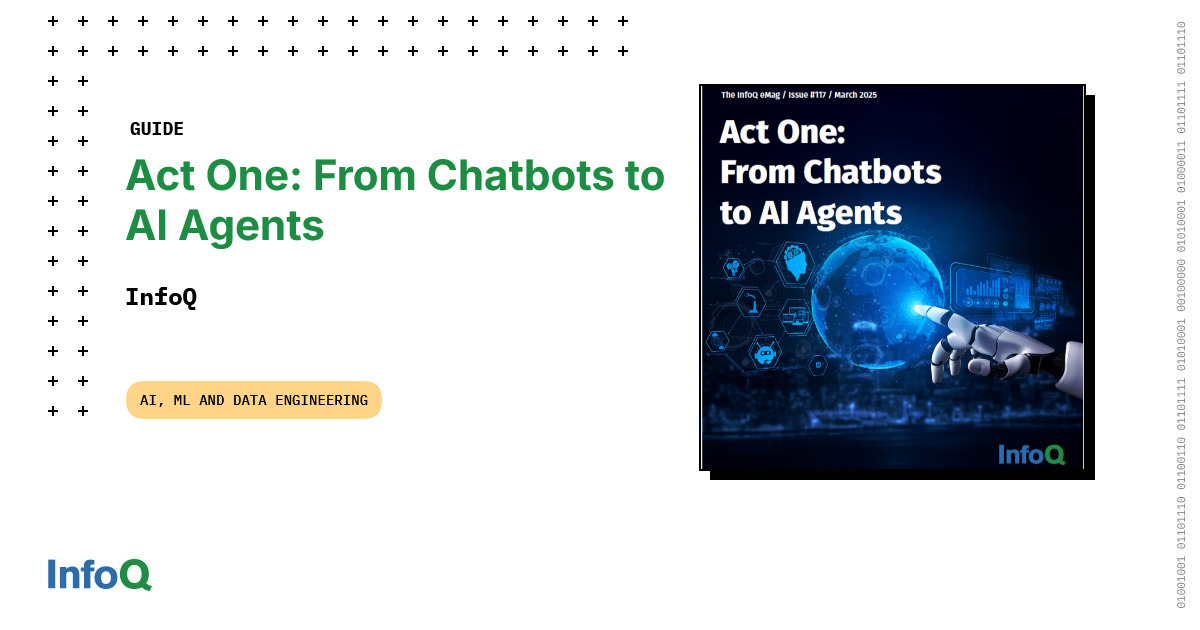
The Act One: From Chatbots to AI Agents eMag marks a pivotal moment in the evolution of artificial intelligence, a shift from the familiar realm of chatbots to the more dynamic and autonomous world of AI agents. We’ve curated a collection of articles that explore this exciting transition, offering both practical insights and forward-looking perspectives on the challenges and opportunities that lie ahead. This paradigm shift has the potential to revolutionize industries, but also demands a new set of tools, techniques, and ethical considerations.
This edition offers a glimpse into the transformative potential of AI agents. We believe this is just the beginning of a much longer story. We invite you to join us on this journey as we continue to explore the exciting world of AI and its profound impact on our future.
Free download
MMS • InfoQ
Ready to earn recognition for your software development knowledge and expertise? The InfoQ Team is happy to invite you to participate in our annual article writing competition. Authors of top-rated articles will win complimentary tickets to prominent software development conferences such as QCon and InfoQ Dev Summit.
What’s in for you?
Prize Details
The authors of the articles that raise the most interest and/or appreciation from the community will be rewarded with a complimentary ticket to one of our events, as follows:
If you are unable to attend in person, you can opt-in for the Video-Only access to most sessions and keynotes for 6 months.
In-person tickets for QCon or InfoQ Dev Summit events do not include any other costs that your attendance on-site might include, such as but not limited to: accommodation, travel, etc.
Further benefits
Being published on InfoQ is an excellent opportunity to grow your career and build connections with the software community. In addition, other developers can learn from you, and they in turn, can contribute back to the community in the future.
- Earn peer recognition
- Enhance your professional reputation
- Make a real difference in the software development community
Key dates
Only article proposals submitted within the established period will be considered:
- Submissions opening: March 01, 2025
- Submissions closing: March 30, 2025
- Winners to be announced: May 30, 2025
How to participate
- Read the author guidelines
- Submit your proposal through the 2025 contest form
- For early feedback or additional questions, send your title and abstract to editors@infoq.com
Article Requirements
We think that the story is best told by developer to developer, architect to architect, and team lead to team lead. That’s why we focus on in-depth technical articles written by domain practitioners and experts. The main requirements to consider before sending a proposal:
- Length: 2,000-3,000 words
- Focus: Technical insights, architectural decisions, or emerging technology implementation
- Target Audience: Senior software engineers, architects, and team leads
Content Guidelines
To ensure the best chance of having your article accepted, it should be:
- Technically substantial with specific, actionable takeaways
- Focused on emerging trends in software development
- Based on real-world implementation experience
- Free from marketing content
- Complete guidelines on the public InfoQ page.
If you would like feedback regarding the suitability of an article proposal before writing the actual draft, please send us a title and abstract. However, the acceptance is always based on the complete article draft; first drafts are also considered. Contact us at editors@infoq.com for any questions or further information.
Selected topics
We welcome articles that fit into the innovator and early adopter stages of the following topics: AI, ML and Data Engineering, Software Architecture & Design, DevOps & Cloud.
Here is a more detailed list of the sub-topics for each topic:
[Click on topic name to display full list of sub-topics selected for the article contest]
AI, ML, & Data Engineering
Retrieval Augmented Generation (RAG), AI powered hardware, Small Language Models (SLMs), AI in Robotics aka Embodied AI, LangOps or LLMOps, Knowledge Graphs, Explainable AI, Brain Computer Interfaces, Automated Machine Learning (AutoML), Edge Interference and model training, large-scale distributed deep-learning, Generative AI/ Large Language Models (LLMs), Synthetic Data Generation, Cloud Agnostic Computing for AI, Vector Databases, Data Contracts, Data Observability, Virtual Reality – e.g. VR/AR/MR/XR, MLOps, Cognitive Services, Graph Data Analytics, IoT Platforms.
Software Architecture & Design
Cell-Based Architecture, Privacy Engineering, Green Software, GraphQL federation, НТТР/3, dApps, Platform Architecture, Socio-technical Architecture Large language models, Edge Computing, Data-Driven Architecture, Dapr, WebAssembly, Micro frontends,AsyncAPI, OpenTelemetry.
Cloud & DevOps
Data Observability, Data Mesh, Cross-cloud uniform infra automation, Application definition and orchestration, Low-code platforms, SLOS, Platform Engineering teams, Industry aggregated incident analysis, Quantum cloud computing, WebAssembly (Wasm), eBPF, Policy as Code, Service mesh, Software secure supply chain, Cross-cloud/Cloud-native hybrid approaches, No copy data sharing, Sustainability accounting, AI/ML Ops, Active-active Global DB Ops, Fullstack tracing, Continuous Testing, ChatOps, DataOps, Developer Experience “DevEx”, Documentation as code, Security in the age of AI, Container Security and Observability in Kubernetes Environments, DevSecOps Best Practices for Identity & Access Management, Best Practices for API Quality and Security.
Winner Selection Process
Winners will be determined by evaluating:
- Reader interest (page views within 14 days of publication)
- Social media impact (engagement on LinkedIn, X, and Facebook)
Here’s how we’ll select the winners: We’ll identify the top three articles based on page views within 14 days of publication. From those three, the article with the most social media engagement across the listed platforms will be awarded 1st place, the second-most engaged will receive 2nd place, and the third, 3rd place.
Page views will be counted for 14 calendar days from the article’s publication date to ensure fair competition.
Winners will be notified by email and publicly announced on our social media channels, on 30 May 2025.
Ready to join the contest? Send your proposal now: 2025 articles contest form.
MMS • InfoQ
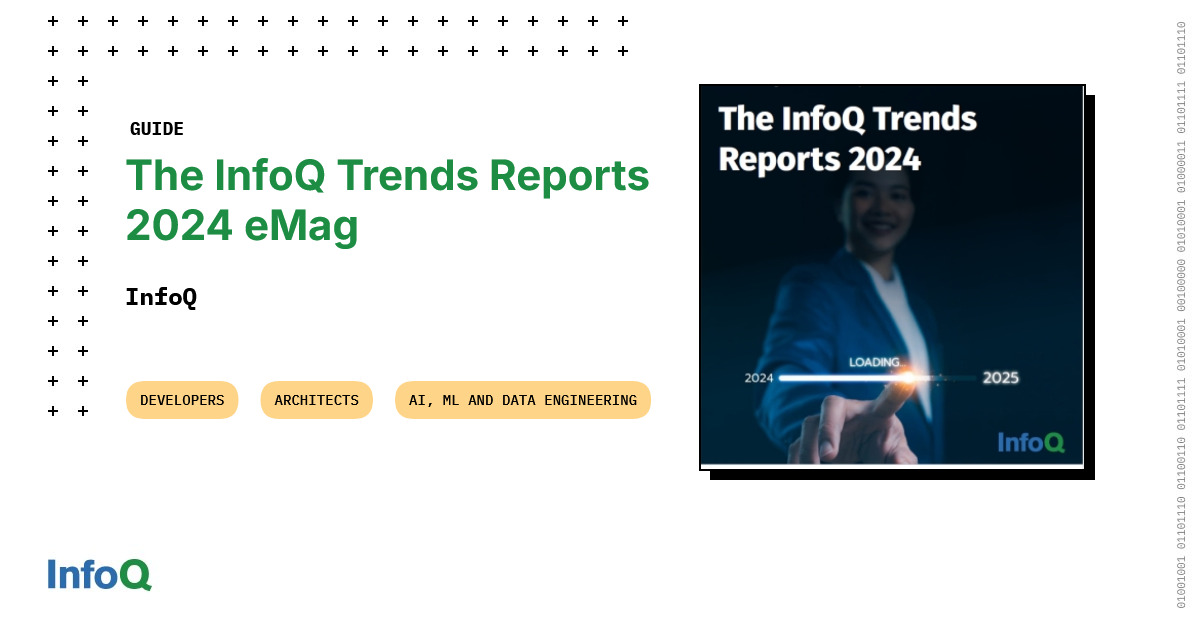
Welcome to this special edition of The InfoQ eMag, which contains a comprehensive collection of our popular InfoQ Trends Reports from 2024. Our reports have delved into the latest advancements, challenges, and future directions. We have aimed to provide insight into cell-based architectures, working within socio-technical systems, large and small language models (LLMs and SLMs), and the state-of-the-art within the Java ecosystem.
This collection does not just reflect the past year’s technological trends. We aspire to use it as a guide for future exploration and innovation. Each report serves as a lens through which we view the world of software development and delivery. Whether you’re a developer, architect, technology leader, or enthusiast, these reports offer valuable perspectives to help you plan your future roadmaps and explore emerging technologies and practices.
Free download
MMS • InfoQ
Platform engineering has become a hot topic over the last several years. Although Netflix, Spotify, and Google may have led the way by focusing on building platforms, creating “golden paths” and cultivating developer experience over the last decade, many organisations are now intentionally building internal developer platforms to follow suite. The need to deliver software with speed, safety, and efficiency has driven the rise of platforms designed “as a product” with the internal customer, the developer, front and centre.
In this InfoQ emag, we aim to inspire and guide platform engineers into building effective platforms and delivering exceptional developer experience.
Free download
MMS • InfoQ
How can we architect software for a greener future? How can a company ensure highly reliable online stateful systems? What are the major scaling challenges? How can we tackle complexity in a serverless application? And, by the way, how can we identify good and poor architects?
Software architecture can be viewed from many perspectives, such as technical, business, and organizational. This eMag will explore the different lenses and discuss the implications of each perspective for software design and development.
Free download
This eMag includes:
-
“The Set Piece Strategy: Tackling Complexity in Serverless Applications” by Sheen Brisals discusses how to decompose complexity, breaking down issues into parts to effectively address each one. Furthermore, we should develop sustainable applications by leveraging the features offered by serverless technology, such as optimization, robust availability, and scalability.
-
“How to Architect Software for a Greener Future” by Sara Bergman discusses how to design green software, highlighting the difference between carbon awareness and carbon efficiency. While operational efficiency may not be the most glamorous option, it is a practical and achievable step almost everyone can take to build greener software.
-
“Thinking Like an Architect” by Gregor Hohpe debunks the myth of software architects as the smartest people on the team. Hohpe argues that architects make everyone else smarter by sharing decision models and revealing blind spots. By explaining the roles of an architect and the concept of connecting levels, he delves into the importance of metaphors for making complex technical concepts more relatable.
-
“Scaling Challenges: Productivity, Cost Efficiency, and Microservice Management” by Milena Nikolic discusses how Trainline’s systems architecture and online ticket purchasing have evolved and what the future holds. Nikolic argues that centralizing cost-saving initiatives leads to more efficient resource allocation and reduces the risks associated with decentralized efforts.
-
“How Netflix Ensures Highly-Reliable Online Stateful Systems” by Joseph Lynch explains what reliability means: investing to reduce the probability of failure, the blast radius, and recovery time to zero, across all deployment components: clients, servers, and APIs. Reliable servers must be redundant, workload-optimized, and heavily cached, with quick data recovery and the ability to leverage multiple replicated copies.
InfoQ eMags are professionally designed, downloadable collections of popular InfoQ content – articles, interviews, presentations, and research – covering the latest software development technologies, trends, and topics.
We hope you find value in the articles and resources in this eMag and are inspired by the practical solutions provided by the authors. We would love to receive your feedback via editors@infoq.com about this eMag.