Author: Steef-Jan Wiggers

MMS • Steef-Jan Wiggers

Microsoft has released the first beta of its official Azure SDK for Rust, enabling Rust developers to interact with Azure services. The initial release includes libraries for essential components such as Identity, Key Vault (secrets and keys), Event Hubs, and Cosmos DB.
This move signifies Microsoft’s recognition of the growing importance and adoption of the Rust programming language, both within the company and in the broader developer ecosystem. Rust is gaining popularity due to its performance, reliability, and memory safety features, making it well-suited for systems programming and high-performance applications. Its strong type system and ownership model help prevent common programming errors, leading to more secure and stable code. At the same time, its modern syntax and tooling contribute to a positive developer experience.
The beta SDK provides Rust developers with libraries designed to integrate with Rust’s package management system (cargo) and coding conventions. The included libraries, known as “crates” in the Rust ecosystem, can be added as dependencies to Rust projects using the cargo add command.
For example, to use the Identity and Key Vault Secrets libraries, they can run the following command:
cargo add azure_identity azure_security_keyvault_secrets tokio --features tokio/full
Next, the developer can import the necessary modules from the Azure SDK crates. The code for creating a new secret client using the DefaultAzureCredential would look like this:
#[tokio::main]
async fn main() -> Result<(), Box> {
    // Create a credential using DefaultAzureCredential
    let credential = DefaultAzureCredential::new()?;
    // Initialize the SecretClient with the Key Vault URL and credential
    let client = SecretClient::new(
        "https://your-key-vault-name.vault.azure.net/,"
        credential.clone(),
        None,
    )?;

    // Additional code will go here...

    Ok(())
}
After the Azure SDK release for Rust, Microsoft´s Cosmos DN team released the Azure Cosmos DB Rust SDK, which provides an idiomatic API for performing operations on databases, containers, and items. Theo van Kraay, a product maanger for Cosmos DB at Microsoft, wrote:
With its growing ecosystem and support for WebAssembly, Rust is increasingly becoming a go-to language for performance-critical workloads, cloud services, and distributed systems like Azure Cosmos DB.
While Microsoft is now officially entering the Rust cloud SDK space with this beta release, Amazon Web Services (AWS) already offers a mature and official AWS SDK for Rust. This SDK provides a comprehensive set of crates, each corresponding to an AWS service, allowing Rust developers to build applications that interact with the vast array of AWS offerings.
Looking ahead, Microsoft plans to expand the Azure SDK for Rust by adding support for more Azure services and refining the existing beta libraries. The goal is to stabilize these libraries and provide a robust and user-friendly experience. Future improvements are expected to include buffering entire responses in the pipeline to ensure consistent policy application (like retry policies) and deserializing arrays as empty Vec in most cases to simplify code.
Lastly, developers interested in getting started with the Azure SDK for Rust can find detailed documentation, code samples, and installation instructions on the project’s GitHub repository. They can also look for new releases from the SDK.
MMS • Steef-Jan Wiggers

Google Cloud has unveiled its new A4 virtual machines (VMs) in preview, powered by NVIDIA’s Blackwell B200 GPUs, to address the increasing demands of advanced artificial intelligence (AI) workloads. The offering aims to accelerate AI model training, fine-tuning, and inference by combining Google’s infrastructure with NVIDIA’s hardware.
The A4 VM features eight Blackwell GPUs interconnected via fifth-generation NVIDIA NVLink, providing a 2.25x increase in peak compute and high bandwidth memory (HBM) capacity compared to the previous generation A3 High VMs. This performance enhancement addresses the growing complexity of AI models, which require powerful accelerators and high-speed interconnects. Key features include enhanced networking, Google Kubernetes Engine (GKE) integration, Vertex AI accessibility, open software optimization, a hypercompute cluster, and flexible consumption models.
Thomas Kurian, CEO of Google Cloud, announced the launch on X, highlighting Google Cloud as the first cloud provider to bring the NVIDIA B200 GPUs to customers.
Blackwell has made its Google Cloud debut by launching our new A4 VMs powered by NVIDIA B200. We’re the first cloud provider to bring B200 to customers, and we can’t wait to see how this powerful platform accelerates your AI workloads.
Specifically, the A4 VMs utilize Google’s Titanium ML network adapter and NVIDIA ConnectX-7 NICs, delivering 3.2 Tbps of GPU-to-GPU traffic with RDMA over Converged Ethernet (RoCE). The Jupiter network fabric supports scaling to tens of thousands of GPUs with 13 Petabits/sec of bi-sectional bandwidth. Native integration with GKE, supporting up to 65,000 nodes per cluster, facilitates a robust AI platform. The VMs are accessible through Vertex AI, Google’s unified AI development platform, powered by the AI Hypercomputer architecture. Google is also collaborating with NVIDIA to optimize JAX and XLA for efficient collective communication and computation on GPUs.
Furthermore, a new hypercompute cluster system simplifies the deployment and management of large-scale AI workloads across thousands of A4 VMs. This system focuses on high performance through co-location, optimized resource scheduling with GKE and Slurm, reliability through self-healing capabilities, enhanced observability, and automated provisioning. Flexible consumption models provide optimized AI workload consumption, including the Dynamic Workload Scheduler with Flex Start and Calendar modes.
Sai Ruhul, an entrepreneur on X, highlighted analyst estimates that the Blackwell GPUs could be 10-100x faster than NVIDIA’s current Hopper/A100 GPUs for large transformer model workloads requiring multi-GPU scaling. This represents a significant leap in scale for accelerating “Trillion-Parameter AI” models.
In addition, Naeem Aslam, a CIO at Zaye Capital Markets, tweeted on X:
Google’s integration of NVIDIA Blackwell GPUs into its cloud with A4 VMs could enhance computational power for AI and data processing. This partnership is likely to increase demand for NVIDIA’s GPUs, boosting its position in cloud infrastructure markets.
Lastly, this release provides developers access to the latest NVIDIA Blackwell GPUs within Google Cloud’s infrastructure, offering substantial performance improvements for AI applications.
MMS • Steef-Jan Wiggers
AWS recently introduced a new enhancement with direct message publishing over WebSocket connections for AWS AppSync Events, a fully-managed serverless WebSocket API service.
Earlier, the company released AWS AppSync Events, which allows developers to easily broadcast real-time event data to a few or millions of subscribers using secure and performant Serverless WebSocket APIs.
Darryl Ruggles, a cloud solutions architect and AWS Community Builder, tweeted on X:
Appsync Events came out a few months ago as a managed/serverless WebSocket API. There are other approaches to using WebSockets on AWS, but this works well for many cases. Now, support has been added for publishing messages directly over WebSocket connections.
Brice Pellé, a principal product manager at AWS, wrote in an announcement blog post:
This update allows developers to use a single WebSocket connection for both publishing and receiving events, streamlining the development of real-time features and reducing implementation complexity.
Developers gain flexibility by choosing between HTTP endpoints for backend publishing and WebSocket for web and mobile client applications. This enhancement will enable developers to build more responsive and engaging real-time applications, such as collaborative tools and live dashboards.
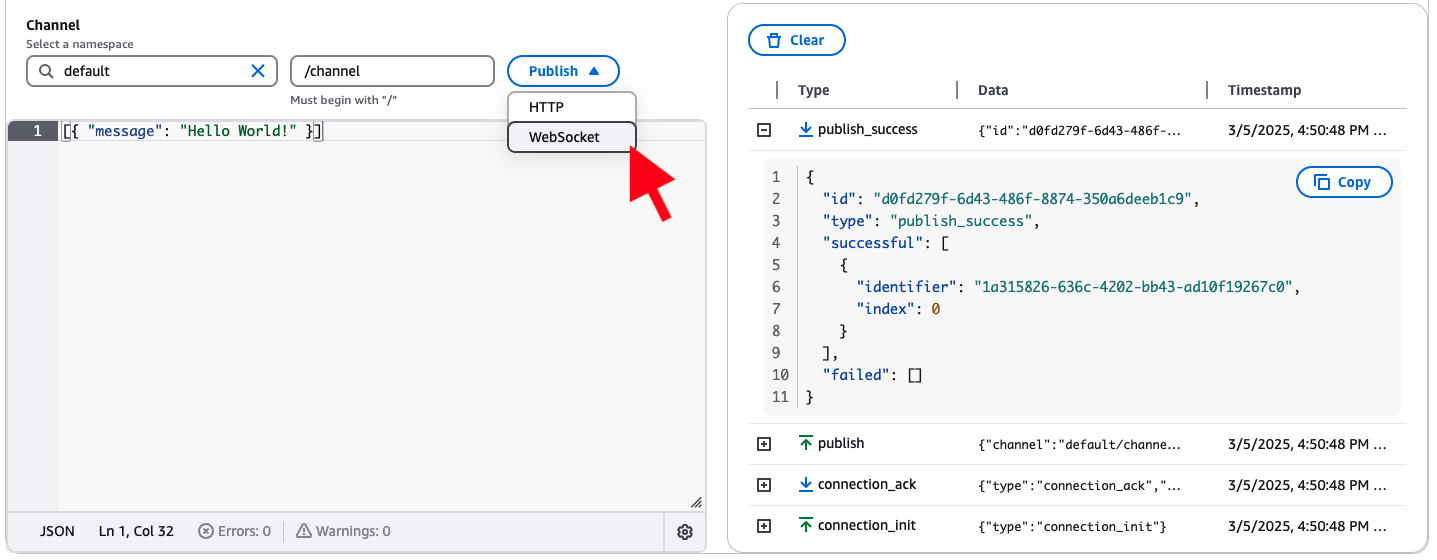
Developers can immediately test the new WebSocket publishing feature through the AppSync console’s Pub/Sub Editor. Selecting “WebSocket” as the publishing method triggers a publish_success message upon successful transmission.
(Source: AWS Front-End Web & Mobile blog post)
AppSync introduces a new “publish” WebSocket operation. After establishing a WebSocket connection, clients can publish events to configured channel namespaces. The message format requires an id, channel, an array of events (up to five), and authorization headers. Each event within the array must be a valid JSON string.
AWS also offers tools for infrastructure management to further streamline the development process. The AWS Cloud Development Kit (CDK) is an infrastructure-as-code framework that simplifies the configuration and deployment of AppSync Event APIs, including channel namespaces and API keys. The CDK consists of the L2 constructs that provide a higher-level abstraction, making it easier for developers to define AppSync Event APIs and their associated channel namespaces using familiar programming languages.
Yoseph Radding, a software engineer, posted on Bluesky:
That’s essentially how AWS CDK works. They define all of these high order constructs (called L2 constructs) the provide great out of the box abstractions. Like the Lambda constructs will create the versions, functions, and IAM roles.
Lastly, publishing over WebSocket is available in all regions where AppSync is supported. The client limit is 25 requests per second per connection. The HTTP endpoint can still be used for higher rates.
MMS • Steef-Jan Wiggers
To streamline video optimization for the explosion of short-form content, Cloudflare has launched Media Transformations, a new service that extends its Image Transformations capabilities to short-form video files, regardless of their storage location, eliminating the need for complex video pipelines.
With the service, the company aims to simplify video optimization for users with large volumes of short video content, such as AI-generated videos, e-commerce product videos, and social media clips.
Traditionally, Cloudflare Stream offered a managed video pipeline, but Media Transformations addresses the challenge of migrating existing video files. By allowing users to optimize videos directly from their existing storage, like Cloudflare R2 or S3, Cloudflare aims to reduce friction and streamline workflows.
(Source: Cloudflare blog post)
Media Transformations enables users to apply various optimizations through URL-based parameters. Using URL parameters, Media Transformations enables automation and integration, allowing dynamic video adjustments without complex code changes – simplifying workflows and ensuring optimized video delivery across various platforms and devices.
The key features of the service include:
- Format Conversion: Outputting videos as optimized MP4 files.
- Frame Extraction: Generating still images from video frames.
- Video Clipping: Trimming videos with specified start times and durations.
- Resizing and Cropping: Adjusting video dimensions with “fit,” “height,” and “width” parameters.
- Audio Removal: Stripping audio from video outputs.
- Spritesheet Generation: creating images with multiple frames.
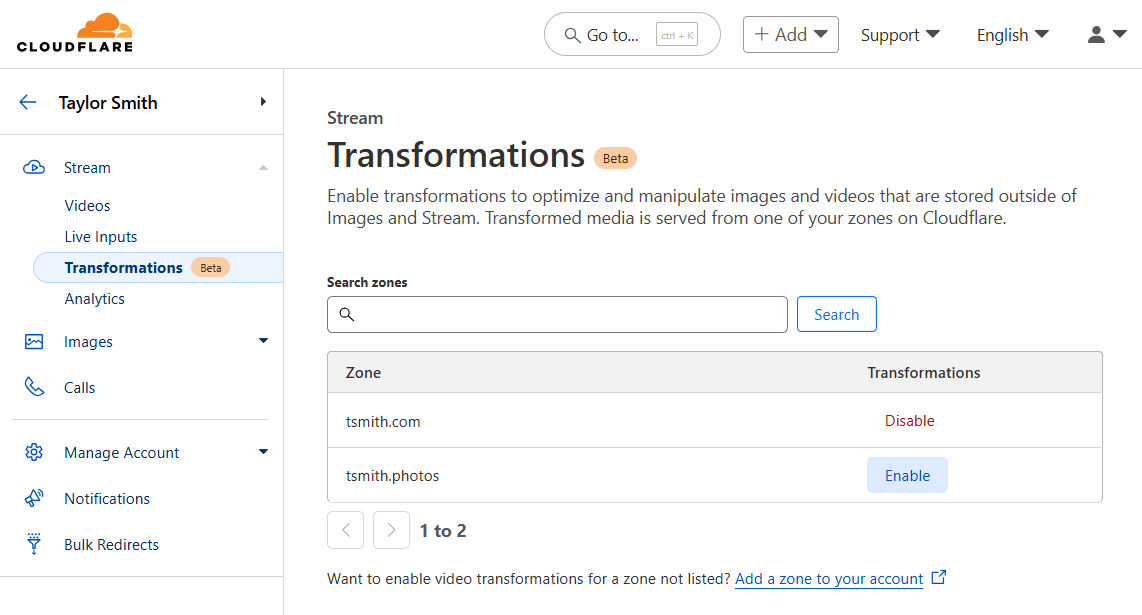
The service is accessible to any website already using Image Transformations and new zones can be enabled through the Cloudflare dashboard. The URL structure for Media Transformations mirrors Image Transformations, using the /cdn-cgi/media/ endpoint.
Initial limitations include a 40MB file size cap and support for MP4 files with h.264 encoding. Users like Philipp Tsipman, founder of CamcorderAI, quickly pointed out the initial limitations, tweeting:
I really wish the media transforms were much more generous. The example you gave would actually fail right now because QuickTime records .mov files. And they are BIG!
Cloudflare plans to adjust input limits based on user feedback and introduce origin caching (Cloudflare stores frequently accessed original videos closer to its servers, reducing the need to fetch them repeatedly from the source).
Internally, Media Transformations leverages the same On-the-Fly Encoder (OTFE) platform Stream Live uses, ensuring efficient video processing. Cloudflare aims to unify Images and Media Transformations to simplify the developer experience further.
In addition to the Cloudflare offering, alternatives are available regarding video optimization, such as Cloudinary, ImageKit, and Gumlet, which have comprehensive features for format conversion, resizing, and compression. Other cloud providers, such as Google Cloud Platform, offer various cloud services, including video processing and delivery solutions. While not solely focused on video transformation, it provides the building blocks for creating custom solutions.
Lastly, Cloudflare highlights use cases such as optimizing product videos for e-commerce, creating social media snippets, and generating thumbnails. The service is currently in beta and free for all users until Q3 2025, after which it will adopt a pricing model similar to Image Transformations.
MMS • Steef-Jan Wiggers

Microsoft has recently introduced a public preview of Azure Database for MySQL trigger for Azure Functions. With these triggers, developers can build solutions that track changes in MySQL tables and automatically trigger Azure Functions when rows are created, updated, or deleted.
Azure Functions is Microsoft’s serverless computing offering. It allows developers to build and run event-driven code without managing infrastructure. Within functions, triggers and bindings are defined. Triggers define how a function runs and can pass data into it. At the same time, bindings connect tasks to resources, allowing input and output data handling – a setup that enables flexibility without hardcoding access to services.
Azure Functions has several triggers such as Queue, Timer, Event Grid, Cosmos DB, and Azure SQL. Microsoft has introduced another one for the Azure Database for MySQL in preview, which bindings monitor the user table for changes (inserts, updates) and invokes the function with updated row data. The Azure Database for MySQL bindings was available in a public preview earlier.
Sai Kondapalli, a program manager at Microsoft, writes in a tech Community blog post:
Similar to the Azure Database for MySQL Input and Output bindings for Azure Functions, a connection string for the MySQL database is stored in the application settings of the Azure Function to trigger the function when a change is detected on the tables.
For the trigger to work, it is necessary to alter the table structure to enable change tracking on an existing Azure Database for MySQL tables to use trigger bindings for an Azure function. A data table will look like this:
ALTER TABLE employees
ADD COLUMN az_func_updated_at TIMESTAMP
DEFAULT CURRENT_TIMESTAMP
ON UPDATE CURRENT_TIMESTAMP;
According to the documentation, the Azure MySQL Trigger bindings use “az_func_updated_at” and column data to monitor the user table for changes. Based on the employee’s table, the C# function would look like this:
using System.Collections.Generic;
using Microsoft.Azure.WebJobs;
using Microsoft.Azure.WebJobs.Extensions.MySql;
using Microsoft.Extensions.Logging;

namespace EmployeeSample.Function
{
    public static class EmployeesTrigger
    {
        [FunctionName(nameof(EmployeesTrigger))]
        public static void Run(
            [MySqlTrigger("Employees", "MySqlConnectionString")]
            IReadOnlyList<MySqlChange> changes,
            ILogger logger)
        {
            foreach (MySqlChange change in changes)
            {
                Employee employee= change. Item;
                logger.LogInformation($"Change operation: {change.Operation}");
                logger.LogInformation($"EmployeeId: {employee.employeeId}, FirstName: {employee.FirstName}, LastName: {employee.LastName}, Company: {employee. Company}, Department: {employee. Department}, Role: {employee. Role}");
            }
        }
    }
}
With the Azure Database for MySQL trigger, developers could build solutions that enable real-time analytics by automatically updating dashboards and triggering alerts with new data. This would allow automated workflows with seamless integration into other Azure services for MySQL data processing. Additionally, it enhances compliance and auditing by monitoring sensitive tables for unauthorized changes and logging updates for security purposes.
While Azure Database for MySQL triggers for Azure Functions offers powerful automation capabilities, developers should consider:
- Scalability: High-frequency updates may lead to function execution bottlenecks. Implementing batching or filtering logic can mitigate performance concerns.
- Supported Plans: The feature is currently only available on premium and dedicated Azure Function plans.
- Compatibility: Ensure that the MySQL version used is compatible with Azure’s bindings and trigger mechanisms.
Microsoft’s investments in MySQL include bindings and triggers in Functions, as well as supporting a newer version of MySQL for Azure database offering, resiliency, migration, and developer experience, as announced at Ignite.
Lastly, developers can find examples of the Azure Database for MySQL Triggers in a GitHub repository.
Google Cloud Introduces Quantum-Safe Digital Signatures in Cloud KMS to Future-Proof Data Security
MMS • Steef-Jan Wiggers

Google recently unveiled quantum-safe digital signatures in its Cloud Key Management Service (Cloud KMS), aligning with the National Institute of Standards and Technology (NIST) post-quantum cryptography (PQC) standards. This update, now available in preview, addresses the growing concern over the potential risks posed by future quantum computers, which could crack traditional encryption methods.
Quantum computing, with its ability to solve problems exponentially faster than classical computers, presents a serious challenge to current cryptographic systems. Algorithms like Rivest–Shamir–Adleman (RSA) and elliptic curve cryptography (ECC), which are fundamental to modern encryption, could be vulnerable to quantum attacks.
One of the primary threats is the “Harvest Now, Decrypt Later” (HNDL) model, where attackers store encrypted data today with plans to decrypt it once quantum computers become viable. While large-scale quantum computers capable of breaking these cryptographic methods are not yet available, experts agree that preparing for this eventuality is crucial.
To safeguard against these quantum threats, Google integrates two NIST-approved PQC algorithms into Cloud KMS. The first is the ML-DSA-65 (FIPS 204), a lattice-based digital signature algorithm; the second is SLH-DSA-SHA2-128S (FIPS 205), a stateless, hash-based signature algorithm. These algorithms provide a quantum-resistant means of signing and verifying data, ensuring that organizations can continue to rely on secure encryption even in a future with quantum-capable adversaries.
Google’s decision to integrate these algorithms into Cloud KMS allows enterprises to test and incorporate quantum-resistant cryptography into their security workflows. The cryptographic implementations are open-source via Google’s BoringCrypto and Tink libraries, ensuring transparency and allowing for independent security audits. This approach is designed to help organizations gradually transition to post-quantum encryption without overhauling their entire security infrastructure.
The authors of a Google Cloud blog post write:
While that future may be years away, those deploying long-lived roots-of-trust or signing firmware for devices managing critical infrastructure should consider mitigation options against this threat vector now. The sooner we can secure these signatures, the more resilient the digital world’s foundation of trust becomes.
Google’s introduction of quantum-safe digital signatures comes at a time when the need for post-quantum security is becoming increasingly urgent. The rapid evolution of quantum computing, highlighted by Microsoft’s recent breakthrough with its Majorana 1 chip, raises concerns over the imminent risks of quantum computers. While these machines are not yet powerful enough to crack current encryption schemes, experts agree that the timeline to quantum readiness is narrowing, with NIST aiming for compliance by 2030.Top of Form
Phil Venables, a chief information security officer at Google Cloud, tweeted on X:
Cryptanalytically Relevant Quantum Computers (CRQCs) are coming—perhaps sooner than we think, but we can conservatively (and usefully) assume in the 2032 – 2040 time frame. Migrating to post-quantum cryptography will be more complex than many organizations expect, so starting now is vital. Adopting crypto-agility practices will mitigate the risk of further wide-scale changes as PQC standards inevitably evolve.
MMS • Steef-Jan Wiggers
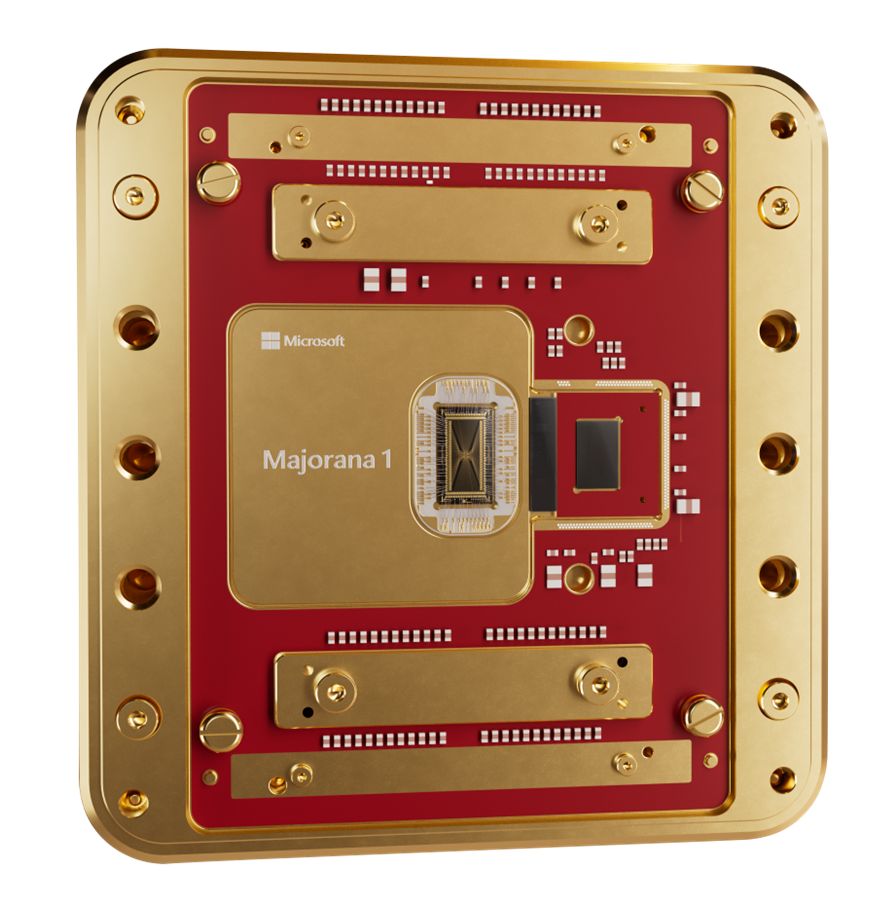
Microsoft recently introduced a quantum chip called Majorana 1 powered by a new Topological Core architecture. The company claims it’s the world’s first Quantum Processing Unit (QPU).
Majorana 1 leverages what the company calls breakthrough material that can observe and control Majorana particles to produce more reliable and scalable qubits, which are the building blocks for quantum computers. In a press release, the company states:
In the same way that the invention of semiconductors made today’s smartphones, computers, and electronics possible, topoconductors and the new type of chip they enable offer a path to developing quantum systems that can scale to a million qubits and are capable of tackling the most complex industrial and societal problems.
The topoconductor, or topological superconductor, creates a unique state of matter that enables the development of stable, fast, and controllable qubits without the trade-offs of existing alternatives. A new study in Nature details how Microsoft researchers created and accurately measured the properties of topological qubits, an essential advancement for practical computing.
In a Microsoft blog, Chetan Nayak, technical fellow and corporate vice president of Quantum Hardware, writes:
Our measurement-based approach dramatically simplifies quantum error correction (QEC). We perform error correction entirely through measurements activated by simple digital pulses that connect and disconnect quantum dots from nanowires. This digital control makes managing the large numbers of qubits needed for real-world applications practical.
However, some researchers are critical of the company’s choice to publicly announce the creation of a qubit without releasing detailed evidence. Georgios Katsaros, a physicist at the Institute of Science and Technology Austria in Klosterneuburg, comments in a Nature article:
Without seeing the extra data from the qubit operation, there is not much one can comment on.
Microsoft’s top conductor comprises indium arsenide (a semiconductor), a material with unique properties currently utilized in applications such as infrared detectors, and aluminum (a superconductor). When cooled to near absolute zero and tuned with magnetic fields, topological superconducting nanowires with Majorana Zero Modes (MZMs) are formed at the wires’ ends. MZMs are the building blocks of Microsoft’s qubits.
(Source: Microsoft Blog Post)
Berci Mesko, a medical futurist, tweeted on X:
Here is Microsoft’s new quantum chip called Majorana 1 that could help realize quantum computers capable of solving meaningful, industrial-scale problems in years, not decades.
Imagine the impact quantum computers could have on healthcare, especially in drug design and diagnostic decision-making. No, we cannot even imagine that. It would bring the impact of AI into a new dimension. I’m not overhyping the technology. This is the scale we have to keep in mind for quantum computing.
Lastly, the Defense Advanced Research Projects Agency (DARPA) has selected Microsoft as one of two finalists in its Underexplored Systems for Utility-Scale Quantum Computing (US2QC) program, part of the broader Quantum Benchmarking Initiative (QBI), which aims to assess quantum systems capable of tackling challenges that classical computers cannot.
AWS Launches Trust Center: a Centralized Resource for Security and Compliance Information
MMS • Steef-Jan Wiggers

AWS has launched the AWS Trust Center, an online resource that explains how the company secures its customers’ assets in the cloud.
With AWS Trust Center, the company provides a view into the company’s security practices, compliance programs, and data protection controls. Chris Betz, a CISO at AWS, writes:
In the Trust Center, you’ll find information about our approach to security at every level—from our physical data centers to our cloud infrastructure and portfolio of cloud services. We’re including documentation about our security services and tools, helping you understand how we secure the cloud and how we help you secure your workloads within it.
The Trust Center provides essential information about AWS’s data protection and privacy practices, including encryption management and operator access controls based on the principle of least privilege. AWS customers can learn about the company’s zero-access designs for key services like AWS Key Management Service (AWS KMS) and Amazon EC2, as well as our global monitoring systems.
Additionally, the Trust Center serves as a central hub for service health and security events, offering access to security bulletins and real-time service status. Customers can easily report security concerns and find resources, agreements, and documentation to help them make informed decisions about their cloud security posture.
Rowan Udell, an AWS security consultant, tweeted:
AWS now has a central location for security and trust content
I’m hoping this makes it easier to reference and share the security and compliance material – It was a bit all over the place, given the size of AWS these days!
In addition, a question was asked in a LinkedIn Post by Jeff Barr on AWS Trust Center if AWS Artifact, which provides on-demand downloads of AWS security and compliance documents, will be replaced. AWS Expert John Krull replied:
It looks like the Trust Center is more generalized and accessible. You need to access Artifact via an account, and the agreements can be accepted under NDA. I think Trust Center will have a wider audience, and I plan to use it to demonstrate AWS’s commitment to security (as job # 0) to business leadership and tech.
Lastly, AWS is not the only hyperscaler offering a trust Center. Other Hyperscalers like Microsoft and Google have similar Trust centers: Microsoft Trust Center provides comprehensive information on security, privacy, compliance, and transparency for Microsoft’s products and services, including Azure, while Google Cloud Trust Center focuses on security, compliance, and privacy to help organizations trust their cloud services.
MMS • Steef-Jan Wiggers
Google Cloud has announced that its Spanner Graph is now generally available (GA). It includes new capabilities such as Graph Notebook, GraphRAG with LangChain integration, Graph schema in Spanner Studio, and Graph query improvements by supporting path data type and functions.
Spanner Graph builds on Cloud Spanner, Google’s fully-managed, scalable, and highly available database. Hence, users can benefit from the same high availability, global consistency, and horizontal scalability.
Last August, the company introduced the database as a unified one that seamlessly integrates graph, relational, search, and AI capabilities with virtually unlimited scalability. The initial release offered an intuitive Graph Query Language (GQL) interface for pattern matching, full graph and SQL model interoperability, built-in search capabilities, and deep integration with Vertex AI for accelerated insights.
The new capabilities with the GA release are:
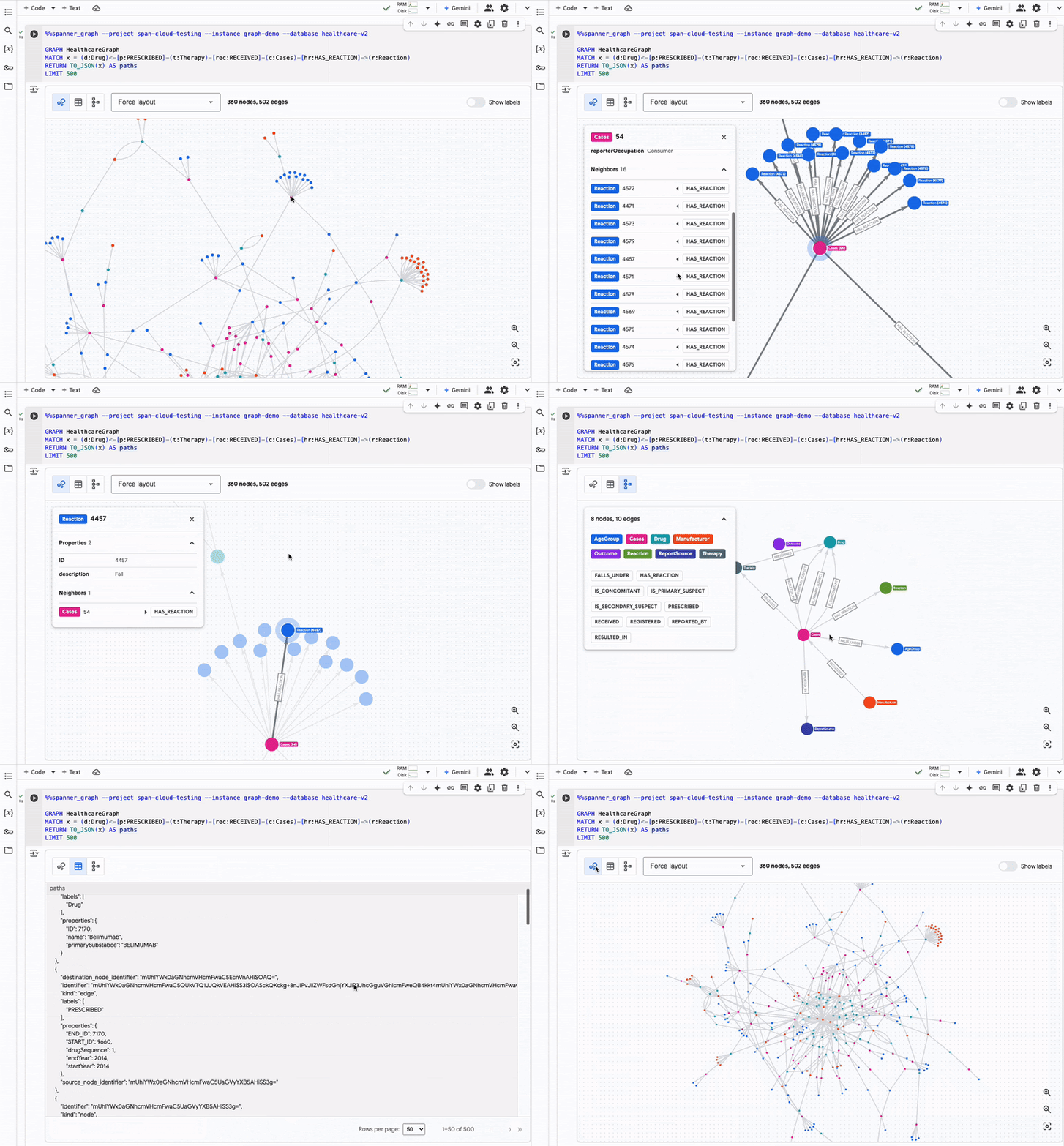
- A Spanner Graph Notebook that enables users to visually query and explore Spanner Graph data using GQL syntax within notebook environments like Google Colab and Jupyter Notebook, offering tools for graph schema visualization, tabular result inspection, various layout options, and easy integration.
- The integration of GraphRAG with LangChain and Neo4j, which enhances AI applications by combining knowledge graphs and Retrieval-Augmented Generation to facilitate efficient querying and natural language interactions with graph-based data.
- The Graph Schema in Spanner Studio that enables users to design, visualize, manage, and update graph schemas in Google Cloud Spanner using SQL/PGQ, offering best practices for efficient graph design and maintenance.
- Support for the path data type and functions, enabling users to analyze sequences of nodes and relationships, as demonstrated by the ability to check for acyclic paths in a graph query.
- Integration with leading graph visualization partners like GraphXR allows users to utilize advanced visualization technology and analytics to understand complex data better.
(Source: Google blog post)
Spanner Graph is designed to handle large-scale graph data workloads, making it ideal for applications that require real-time analysis of complex relationships. This includes use cases such as fraud detection, recommendation engines, and financial investments.
Kinevez, the company that has its visual GraphXR tool integrated with Spanner Graph, tweeted:
With improved search and built-in AI features, Spanner Graph can transform how businesses leverage connected data—whether in financial investing, fraud detection, or customer 360.
In addition, Abdul Rahim Roni commented on a LinkedIn post by Google:
This is an exciting leap forward, Google Cloud. Integrating graph, relational, and generative AI capabilities under Spanner Graph truly redefines database management. Incredible work in pushing the boundaries of innovation.
Lastly, more details are available on the documentation pages.
MMS • Steef-Jan Wiggers
AWS recently announced a new feature for Amazon EventBridge that allows users to deliver events directly to AWS services in different accounts. According to the company, this enhancement enables the use of multiple accounts to improve security and simplify business processes.
Amazon EventBridge Event Bus is a serverless event broker that enables scalable event-driven applications by routing events between applications, third-party SaaS, and AWS services. The newly introduced feature lets users directly target services in another account without additional infrastructure. Chris McPeek, a principal solution architect at AWS, explains in an AWS Compute blog post:
With this new EventBridge feature, you can deliver events directly from the source event bus to the desired targets in different accounts. This simplifies the architecture and permission model and reduces latency in your event-driven solutions by having fewer components process events along the path from source to target.
For example, users can route events from their EventBridge Event Bus to a different team’s SQS queue in another account, with the receiving team only needing to grant Identity Access Management (IAM) permissions for access. Events can be delivered across accounts to targets that support resource-based IAM policies, including Amazon SQS, AWS Lambda, Amazon Kinesis Data Streams, Amazon SNS, and Amazon API Gateway.
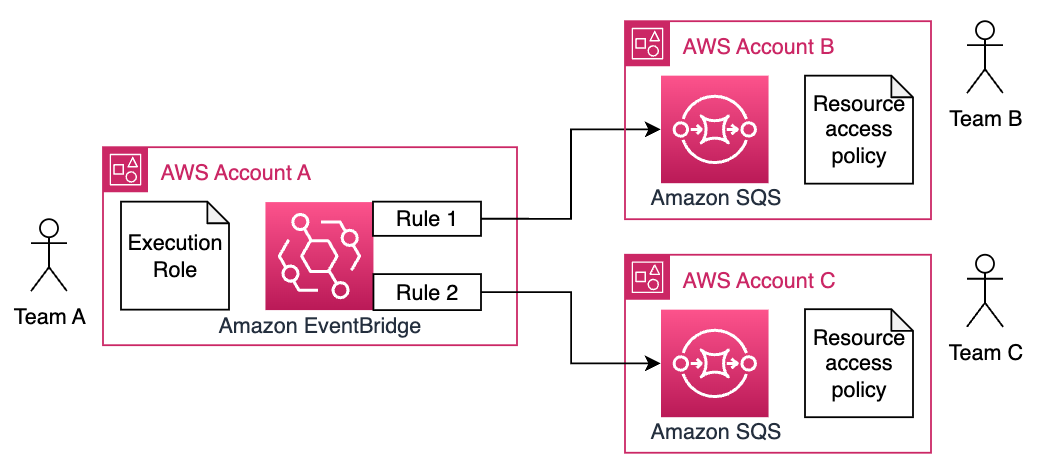
(Source: AWS Compute blog post)
The company recommends enabling cross-account event delivery by establishing mutual trust between source and target accounts. Source event bus rules must use an AWS IAM role to send events to designated targets, achieved by attaching an execution role to those rules.
Targets in different accounts need a resource access policy to receive events from the source account’s execution role. Targets like Amazon SQS queues, Amazon SNS topics, and AWS Lambda functions support this process.
Having an IAM role in the source account and a resource policy in the target account allows for fine-grained control over the PutEvents action. Users can also define service control policies (SCPs) to regulate who can send and receive events in their organization.
To set up cross-account event delivery (assuming the source event bus exists), users can follow these three steps:
- Target account: Create a delivery target (e.g., SQS queue).
- Source account: Configure a rule for event delivery, set the target SQS queue ARN, and attach an execution role with permissions to send messages.
- Target account: Apply a resource policy to the SQS queue to allow the source event bus execution role to send events.
Yan Cui, a Serverless Hero, tweeted on X:
This is AWESOME! EventBridge now delivers events to cross-account targets directly, without having to send them to the default bus in the target account first.
With Cross-Account Event Delivery, AWS brings another feature to the service after adding features like AppSync Integration. In a LinkedIn post, Sheen Brisals, an AWS Serverless Hero, stated:
In a way, this feature now pushes EventBridge to become a ‘true’ enterprise event-streaming platform. There are still gaps to fill, but we are getting there.
Users can find more information and guidance on Amazon EventBridge on the documentation pages and GitHub repository. In addition, more details for the pricing of Event Bridge are available on the pricing page.