Author: Robert Krzaczynski
The White House Releases National AI Strategy Focused on Innovation, Infrastructure, and Global Lead

MMS • Robert Krzaczynski

The White House has published America’s AI Action Plan, outlining a national strategy to enhance U.S. leadership in artificial intelligence. The plan follows President Trump’s January Executive Order 14179, which directed federal agencies to accelerate AI development and remove regulatory barriers to innovation.
The strategy identifies more than 90 federal actions to be taken in the coming months. These are organized across three primary pillars: Accelerating Innovation, Building American AI Infrastructure, and Leading in International Diplomacy and Security.
The plan outlines a range of federal initiatives aimed at strengthening the U.S. AI ecosystem and positioning the country as a global leader in the field:
- AI Exports: Support for allied nations through full-stack AI packages, including hardware and software.
- Infrastructure: Faster permitting for data centers and fabs, plus workforce training in key technical trades.
- Deregulation: Review and removal of federal rules that may hinder AI development, with industry input.
- Procurement: New guidelines favor “ideologically neutral” frontier models in federal contracts.
According to Michael Kratsios, Director of the White House Office of Science and Technology Policy, the initiative aims to align government efforts in building a stronger national AI ecosystem. Administration officials have described the effort as a response to global competition in AI development and deployment.
The plan’s focus on deregulation and rapid buildout has prompted a range of responses. Some have raised concerns about the risks of easing oversight in high-impact sectors. One Reddit user compared the approach to hypothetical deregulation in the aviation industry:
Deregulation means average citizens have to suffer in one way or another. Imagine deregulation in aviation just to compete — fewer safety measures, and who cares if more planes crash? This doesn’t happen because of strict regulation.
Security was another area of concern. While the plan references the “secure by design” principle, some observers argue that more detail is needed regarding the protection of the underlying systems running AI applications:
While one of the pillars prioritizes the ‘secure by design’ concept, a lot of the controls focus on LLM input/output validation. These applications also need hardened runtimes, like any other production software.
The strategy also emphasizes avoiding what officials describe as “Orwellian” applications of AI and ensuring that American workers are central to the AI-driven economy. Officials say the buildout will create skilled jobs and technological opportunities across sectors, from medicine to manufacturing.
The White House says implementation of the plan will begin immediately, with coordination across federal agencies. More details on timelines, specific agency responsibilities, and international partnerships are expected in the coming weeks.
MMS • Robert Krzaczynski
Qwen Team has announced Qwen3-Coder, a new family of agentic code models designed for long-context, multi-step programming tasks. The most capable variant, Qwen3-Coder-480B-A35B-Instruct, is a Mixture-of-Experts model with a total of 480 billion parameters and 35 billion active parameters per forward pass. It supports 256K tokens natively and up to 1 million via context extension, aiming to handle repository-scale inputs and extended tool interactions.
Unlike static code generation models, Qwen3-Coder emphasizes execution and decision-making. The model was post-trained using reinforcement learning over a broad set of real-world tasks, where success is defined by whether the generated code runs and solves the problem. This approach, referred to by Qwen as “Hard to Solve, Easy to Verify”, aims to improve robustness and utility.
In addition, the team scaled long-horizon agentic RL, training the model to use tools and respond to multi-turn feedback in simulated environments. To support this, Qwen deployed a system capable of running 20,000 parallel environments on cloud infrastructure, enabling scaled agent training on workflows resembling actual developer activity.
To support experimentation, Qwen released Qwen Code, an open-source command-line interface forked from Gemini CLI. It features custom prompt structures and enhanced support for tool use and function calling. The tool can be installed via npm and supports OpenAI-compatible APIs.
In addition, Claude Code users can route requests through DashScope using proxy or router configuration options. This provides a familiar coding interface while enabling evaluation of Qwen3-Coder’s outputs in a multi-model setup.
CLI tools are compatible with Cline, Node.js, and Python environments, with full environment variable and API support.
Qwen3-Coder is currently available through DashScope via API. Developers outside mainland China can use the international endpoint, and sample Python code is provided for quick integration. Additional model sizes are expected to be released soon, with a focus on maintaining performance while lowering inference cost.
Some Reddit users have noted that while local deployment is possible, running the larger models efficiently requires significant infrastructure:
Qwen3-Coder’s local use isn’t a cost-saver unless you’ve got the right multi-GPU setup. Running smaller versions when they release might lower expenses. Balancing GPU costs with cloud or hosted solutions could offer a better approach depending on your workload needs. Power and maintenance are key factors too.
Future work includes expanding the capabilities of the Qwen Coding Agent and exploring mechanisms for self-improvement, where agents can iteratively improve performance across tasks with minimal human supervision.
MMS • Robert Krzaczynski

Perplexity has introduced Comet, a new web browser designed to integrate natural language interaction directly into the browsing experience. Unlike conventional browsers built around navigation and search, Comet aims to support users in research, comparison, and task execution by combining browsing with persistent context and AI assistance.
The browser includes a built-in assistant that remains available across sessions and tabs, allowing users to ask follow-up questions, summarize content, and perform actions such as booking meetings or writing emails. Instead of switching between applications or copying information across tools, Comet supports an interaction model where queries can be posed and refined inline, with the assistant handling tasks in context.
According to Perplexity, Comet is designed to address common friction points in how people interact with information online. Instead of opening dozens of tabs or copying content between tools, users interact with an integrated assistant that can interpret intent, maintain context, and take action.
Some of the browser’s core capabilities include:
- Conversational browsing: Users can ask questions about what they’re reading, compare information across sources, or automate tasks without leaving the page.
- Session memory: The assistant maintains context across tabs, allowing multi-step reasoning and cumulative research.
- Task execution: Basic actions, such as emailing, summarizing, or product comparison, can be triggered by natural language instructions.
Comet is currently available to Perplexity Max subscribers via an invite-based rollout. Broader access is planned over the summer.
Some early adopters have noted concerns with the current distribution model and performance:
Only issue is this invite thing. I have received mine & use it. However, this model of distribution is flawed. I think ARC’s lack of meaningful traction was in part due to this… There isn’t time to be cute. Get it out to as many people who want to try it.
Others report mixed experiences with real-world usage:
I was using it at work for a bit, but I’ve switched back to Chrome/Edge. Comet is slower than both and doesn’t really add any value yet. Plus, my IT department is confused or something because some pages are blocked when I access with Comet, but work in other browsers.
Despite some limitations at launch, Comet reflects a broader trend toward embedding assistant technologies into core productivity tools. Perplexity has stated that future updates will expand capabilities and incorporate user feedback, with the long-term goal of making the browser a more dynamic and contextual interface for interacting with the web.
MMS • Robert Krzaczynski
LM Studio has released version 0.3.17, introducing support for the Model Context Protocol (MCP) — a step forward in enabling language models to access external tools and data sources. Originally developed by Anthropic, MCP defines a standardized interface for connecting LLMs to services such as GitHub, Notion, or Stripe, enabling more powerful, contextual reasoning.
With this release, LM Studio becomes an MCP Host, capable of connecting to both local and remote MCP servers. Users can add servers by editing a mcp.json configuration file within the app or by using the new “Add to LM Studio” one-click integration buttons when available.
Each MCP server runs in a separate, isolated process. This architecture ensures modularity and stability while maintaining compatibility with local environments. LM Studio supports MCPs that depend on tools like npx, uvx, or any system command, provided these are installed and accessible through the system’s PATH variable.
Security and user agency are central to the design. When a model attempts to call a tool through an MCP server, LM Studio displays a tool call confirmation dialog, where users can inspect, approve, modify, or deny the action. Tools can be whitelisted for future calls, and settings can be managed globally via the “Tools & Integrations” menu.
An example use case is the Hugging Face MCP Server, which allows models to access Hugging Face’s APIs to search for models or datasets. Users simply enter their API token into the config, and the server becomes accessible from within the LM Studio environment. This functionality is useful for LLM developers who want to augment their local models with structured, live data from third-party APIs.
The project has already seen interest from the community. On LinkedIn, Daniele Lucca, a project manager at Xholding Group, commented:
Fantastic news! This is exactly the experiment I’m carrying out as a passion project. I’m using external data sources to ‘teach’ an AI with 20 years of data of issues, solutions, manuals from my industry, AIDC (Automatic Identification and Data Capture).
Still, some users have reported early issues. One Reddit user noted:
I just wish I could load the list of models. For some reason, I am getting an error when trying to search for a model. Anyone else facing this?
Another replied:
It happened to me 2 days ago. Yesterday it was fine. So I think it is intermittent.
LM Studio encourages the community to file bug reports via their GitHub issue tracker as MCP support evolves.
Version 0.3.17 is available now via in-app update or direct download at lmstudio.ai.
MMS • Robert Krzaczynski
Google has released Gemini CLI, a new open-source AI command-line interface that brings the full capabilities of its Gemini 2.5 Pro model directly into developers’ terminals. Designed for flexibility, transparency, and developer-first workflows, Gemini CLI provides high-performance, natural language AI assistance through a lightweight, locally accessible interface.
Gemini CLI is available today under the Apache 2.0 license, enabling developers to inspect, modify, and extend the source code. It features deep integration with Gemini Code Assist, allowing developers to seamlessly shift between IDE-based and terminal-based AI assistance using the same model backbone.
Key capabilities of Gemini CLI include:
- Support for Gemini 2.5 Pro with a 1 million token context window
- Prompt grounding with Google Search, enabling real-time web context integration
- Built-in support for the Model Context Protocol (MCP) and custom system prompts (via GEMINI.md)
- Non-interactive scripting mode, allowing terminal automation with AI as part of CI/CD workflows
Once authenticated with a personal Google account, developers can access Gemini CLI for free under a Gemini Code Assist license. Advanced users can alternatively configure Gemini CLI with API keys from Google AI Studio or Vertex AI for more control or higher-volume use cases.
Gemini CLI supports a range of developer workflows, including:
- Writing, refactoring, and debugging code
- Automating terminal tasks and shell scripting
- Researching technical topics or documentation
- Generating structured content or markdown
- Performing local file and system-level operations
The project is intended to evolve with community input, and contributions are encouraged via the Gemini CLI GitHub repository. Google highlights that this release continues the company’s shift toward open, extensible AI tooling aimed at democratizing access to powerful models across platforms.
However, initial user feedback points to areas that still need refinement. One developer commented:
Tried a bit just now; for my not-too-difficult task, it firstly searched a codebase for 4 minutes, then ended up asking to explore the code in another codebase, to which all calls were commented out. Doesn’t feel close to Claude Code yet.
Another Reddit user added:
Well, it is fine until 5 minutes into the session, when it switches the model to flash, which is entirely awful at coding.
For developers who prefer working in an IDE, Gemini Code Assist now shares agent technology with Gemini CLI. This includes multi-step planning, auto-recovery, and reasoning-based code generation in VS Code, offered free across all tiers.
Gemini CLI is available today at cli.gemini.dev and requires only a Google login to get started.
Google DeepMind Unveils AlphaGenome: A Unified AI Model for High-Resolution Genome Interpretation
MMS • Robert Krzaczynski

Google DeepMind has announced the release of AlphaGenome, a new AI model designed to predict how genetic variants affect gene regulation across the entire genome. It represents a significant advancement in computational genomics by integrating long-range sequence context with base-pair resolution in a single, general-purpose architecture.
AlphaGenome processes up to 1 million base-pairs of DNA at once and outputs high-resolution predictions across thousands of molecular modalities, including gene expression, chromatin accessibility, transcription start sites, RNA splicing, and protein binding. It allows researchers to evaluate the effects of both common and rare variants, not just in protein-coding regions, but in the far more complex non-coding regulatory regions that constitute 98% of the human genome.
Technically, AlphaGenome combines convolutional neural networks (CNNs) to detect local sequence motifs and transformers to model long-range interactions, all trained on rich multi-omic datasets from ENCODE, GTEx, 4D Nucleome, and FANTOM5. The architecture achieves state-of-the-art performance across a broad range of genomic benchmarks, outperforming task-specific models in 24 out of 26 evaluations of variant effect prediction.
A notable innovation is AlphaGenome’s ability to directly model RNA splice junctions, a feature crucial for understanding many genetic diseases caused by splicing errors. The model can also contrast mutated and reference sequences to quantify the regulatory impact of variants across tissues and cell types — a key capability for studying disease-associated loci and interpreting genome-wide association studies (GWAS).
Training efficiency was also improved: a full AlphaGenome model was trained in just four hours on TPUs, using half the compute budget of DeepMind’s earlier Enformer model, thanks to optimized architecture and data pipelines.
The model is now available via the AlphaGenome API for non-commercial research use, enabling scientists to generate functional hypotheses at scale without needing to combine disparate tools or models. DeepMind has indicated plans for further extension to new species, tasks, and fine-tuned clinical applications.
This release also aligns with a broader conversation around the interpretability and emotional context of AI in medicine. As Graevka Suvorov, an AI alignment researcher, commented:
The true frontier for MedGemma isn’t just diagnostic accuracy, but the informational and psychological state it creates in the patient. A diagnosis without context is a data point that can create fear. A diagnosis delivered with clarity is the first step to healing. An AI with a true ‘informational bedside manner’—one that understands it’s not just treating an image, but a person’s entire reality—is the next real leap in AGI.
AlphaGenome pushes the field closer to that vision, enabling deeper, more accurate interpretations of the genome and offering a unified model for understanding biology at the sequence level.
MMS • Robert Krzaczynski
The OWASP Foundation has officially introduced the AI Testing Guide (AITG), a new open-source initiative aimed at assisting organizations in the systematic testing and security of artificial intelligence systems. This guide, led by Matteo Meucci and Marco Morana, serves as a fundamental resource for developers, testers, risk officers, and cybersecurity professionals, promoting best practices in AI system security.
As AI technologies become embedded in critical industries—from finance and healthcare to national security—the need for structured, AI-specific testing has grown significantly. Unlike traditional software, AI systems introduce unique challenges, including non-deterministic behavior, data drift, adversarial attacks, and algorithmic bias. The AITG addresses these issues directly using methodologies derived from OWASP’s established practices, including the Web Security Testing Guide (WSTG) and the Mobile Security Testing Guide (MSTG).
The AI Testing Guide focuses on areas such as data-centric testing, fairness evaluation, adversarial robustness, privacy validation, and continuous model monitoring. It emphasizes the importance of reproducibility, ethical alignment, and risk mitigation, particularly in high-stakes applications.
Industry professionals have already voiced their support. Michael Tyler, an expert in enterprise security strategy, commented:
OWASP’s AITG is a true game-changer for AI security. As CISOs, we’ve wrestled with AI’s non-deterministic nature and silent data drift. This guide offers a structured path to secure, auditable AI, from prompt injection to continuous monitoring. A vital roadmap for responsible deployment!
Teddy Ramanakasina, an associate director specializing in cybersecurity and IT audit, added:
Great initiative! Structured AI testing is essential to align security, governance, and assurance. Happy to contribute from a risk and audit perspective — looking forward to engaging with the OWASP community.
Similarly, Soulaiman Hajjaj, a cloud and cybersecurity specialist, emphasized the critical need for such a framework:
Excellent initiative! This addresses a critical gap, as a massive number of organisations lack comprehensive AI security frameworks. Structured testing methodologies are non-negotiable for risk mitigation.”
The OWASP AI Testing Guide is designed to be both technology-agnostic and globally relevant, with a roadmap focused on continuous updates to keep pace with AI advancements. OWASP invites developers, researchers, red teamers, and ethical hackers to contribute via its official channels and Slack community.
The project is currently in Phase 1, with a public draft and GitHub repository now live. Community input is being actively encouraged to help refine the guide ahead of its first official release, scheduled for September 2025.
MiniMax Releases M1: A 456B Hybrid-Attention Model for Long-Context Reasoning and Software Tasks
MMS • Robert Krzaczynski
MiniMax has introduced MiniMax-M1, an open-weight language model designed for long-context reasoning and tool use. Based on the earlier MiniMax-Text-01, M1 uses a hybrid Mixture-of-Experts (MoE) architecture and a new “lightning attention” mechanism. The model has a total capacity of 456 billion parameters, with 45.9 billion active per token, and supports context lengths of up to 1 million tokens.
M1 distinguishes itself through its efficient use of compute and support for long-context reasoning. Its lightning attention mechanism reduces test-time computation, requiring only 25% of the FLOPs used by DeepSeek R1 for sequences of 100K tokens. The model was trained using large-scale reinforcement learning across a range of domains, including mathematical problem-solving and software engineering environments.
Two versions of the model are available. The models are evaluated using a custom RL scaling approach. Notably, MiniMax introduces CISPO, a novel RL algorithm that clips importance sampling weights rather than token updates—reportedly improving stability and performance over traditional variants.
Across benchmarks, MiniMax-M1-80K consistently ranks at or near the top among open-weight models, with strong results in:
- Long-context tasks (OpenAI-MRCR 128K: 73.4%, LongBench-v2: 61.5%)
- Software engineering (SWE-bench Verified: 56.0%)
- Tool use (TAU-bench airline: 62.0%, retail: 63.5%)
- Reasoning-heavy math benchmarks (AIME 2024: 86.0%)
One Reddit user commented on its standout capabilities:
This looks pretty great. Especially for function calling (Tau-bench) and long context, this seems like SOTA for open-weights. The latter by some big margin, which I don’t even find unbelievable because their old non-reasoning model was also great for this.
However, others pointed to limitations in practice. For example, dubesor86 shared:
It’s unusable, though. I had it play chess matches (usually takes a few minutes), and I had to have it run all night, and it still wasn’t done by the time I woke up. All the scores in the world mean nothing if the usability is zero.
MiniMax-M1 also supports structured function calling, making it suitable for agent frameworks. The model is available in two versions (40K and 80K) via HuggingFace. For deployment, the team recommends vLLM, offering optimized serving, memory management, and batching performance. Developers can also experiment via the MiniMax MCP Server, which bundles API access and capabilities such as video and image generation, speech synthesis, and voice cloning.
MMS • Robert Krzaczynski

Chris McCord has released Phoenix.new, a browser-native agent platform that gives large language models full-stack control over Elixir development environments. Designed to work entirely in the cloud, Phoenix.new spins up real Phoenix apps inside ephemeral VMs—complete with root shell access, a full browser, GitHub integration, and live deployment URLs—allowing LLM agents to build, test, and iterate in real time.
Phoenix.new allows users to spin up Elixir projects directly in their browser. The agents can install packages, modify code, launch servers, and even run integration tests, all without touching the local machine. Each environment is powered by Fly.io’s infrastructure and behaves like a full development system, complete with a root shell and live preview URLs.
What distinguishes Phoenix.new is its alignment with the Phoenix framework’s real-time and collaborative features. When an agent adds a front-end component, it goes beyond verifying compilation—it launches a browser session, loads the application, and interacts with it programmatically. Updates are reflected live across open preview tabs, enabling continuous feedback during development.
Phoenix.new agents can also explore live databases via CLI tools, propose schema-aware Ecto models, and generate full-stack apps that use WebSockets, LiveView, and Presence. Developers can guide the agents or let them work asynchronously—triaging GitHub issues, generating pull requests, and iterating independently on running codebases.
In a live demo at ElixirConfEU, Phoenix.new generated a functional Tetris game using Phoenix LiveView from a single prompt. While there are few public examples combining LiveView with game logic, the agent was able to draw on general knowledge of web frameworks and interactive applications to complete the task.
While Phoenix.new operates inside Fly.io’s virtual machines, questions have been raised about vendor lock-in. Responding to one such concern on Hacker News, McCord clarified:
Everything starts as a stock phx.new app which uses SQLite by default. Nothing is specific to Fly. You should be able to copy the git clone URL, paste,
cd && mix deps.get && mix phx.serverlocally and the app will just work.
McCord envisions a future where agent collaboration happens not only during coding sessions but continuously, even while developers are offline. With growing support for multiple languages and frameworks beyond Elixir, Phoenix.new is poised to become a powerful entry point for cloud-native, AI-assisted development.
The platform is available now at phoenix.new, with continued updates planned throughout 2025.
MMS • Robert Krzaczynski
AlphaWrite is a new framework designed to enhance creative writing with structure and measurable improvements. Developed by Toby Simonds, it employs an evolutionary process to iteratively boost storytelling quality during inference.
Creative generation has long been a challenge for large language models (LLMs), not due to a lack of fluency, but because of the difficulty in evaluating subjective qualities such as character development, emotional impact, and narrative cohesion. AlphaWrite addresses this by borrowing ideas from evolutionary algorithms and systems like AlphaEvolve, applying them to story generation.
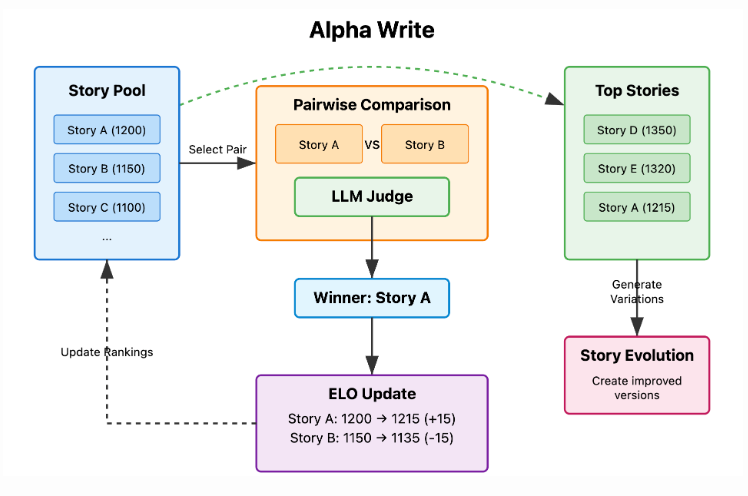
The system operates in iterative cycles. It first generates a broad population of diverse stories, varying in author style and theme. Then, an LLM-based judge conducts pairwise comparisons using a detailed narrative quality rubric and Elo rating system. Top-performing stories are selected to spawn variants with guided improvements in structure, dialogue, or prose, among other dimensions. This process is repeated across generations, aiming to refine stories over time.
Source: tobysimonds.com
As Toby Simonds, a creator of AlphaWrite, shared on X:
The magic is in the evolutionary pressure. Stories don’t just get generated once – they compete, mutate, and improve across generations. Top performers become ‘parents’ for the next generation, while weak stories get replaced by promising variants.
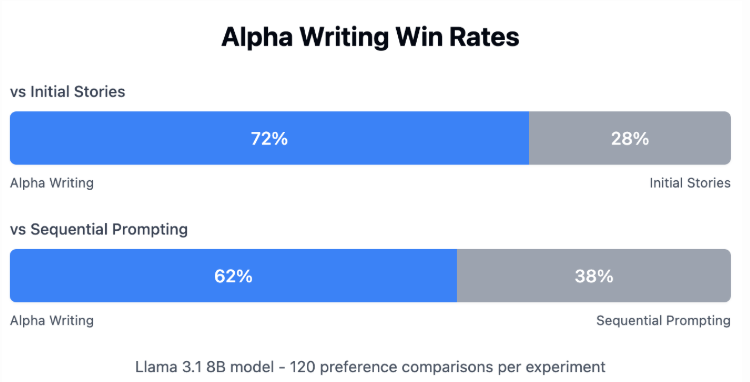
Early experiments using Llama 3.1 8B suggest notable gains. Stories produced by AlphaWrite were preferred 72% of the time over initial single-shot generations and 62% over stories created through sequential prompting, both statistically significant. The system also supports recursive improvement: refined outputs are distilled into the base model, which can then undergo another round of evolution.
Source: tobysimonds.com
While the results are promising, not everyone welcomes the development. One user on Hacker News commented:
If there is something that I would like AI to never touch, it’s that. Please stop making the world worse.
In response, another user added:
Not everyone shares your same worldview… You don’t have to participate; ignore AI-generated or AI-assisted content… But you also don’t have to devalue and dismiss the interests of others.
These differing reactions reflect broader cultural tensions around AI’s role in creative domains—whether it enhances or erodes human expression. The AlphaWrite team acknowledges that evaluating story quality remains subjective and warns of risks like prompt bias and creative convergence.
Nonetheless, AlphaWrite’s potential reaches beyond fiction. The authors note that the system helped draft parts of their paper and could be adapted to technical writing, marketing, and academic content. With suitable rubrics, the method could be applied to optimize specific writing tasks or even to improve foundation models themselves.
The code is available in the AlphaWrite GitHub repository for developers and researchers to explore.