Author: Robert Krzaczynski

MMS • Robert Krzaczynski

Mistral AI has released Magistral, a new model family built for transparent, multi-step reasoning. Available in open and enterprise versions, it supports structured logic, multilingual output, and traceable decision-making.
Magistral is designed for structured, interpretable reasoning across complex tasks in law, finance, healthcare, logistics, and software. It supports multi-step chain-of-thought generation in multiple languages, including Arabic, Chinese, French, German, and Spanish.
Benchmarks show competitive performance:
- Magistral Medium scored 73.6% on AIME 2024, and 90% with majority voting @64
- Magistral Small reached 70.7% and 83.3% respectively
The model emphasizes clarity in logic and step-by-step traceability, making it suitable for use cases where auditability is required, from regulatory compliance to strategic modeling.
Mistral also promotes speed as a key differentiator. With its Flash Answers system in Le Chat, Magistral reportedly achieves up to 10x faster token throughput compared to standard models, supporting real-time interaction and feedback loops. However, early user feedback reflects differing views on the tradeoff between performance and usability. One Reddit user wrote:
10x inference for 10% improvements, and general usability goes down the drain. I personally do not see the use case for this.
The API pricing on the already boosted profits purely from token use does not make sense to me. I tested them for a few hours, but I will never use them again, unlike Mistral Small 3.1, which will remain on my drive.
Concerns also surfaced regarding context length limitations. While many enterprise-grade models are pushing context limits beyond 100K tokens, Magistral currently offers 40K tokens of context. Romain Chaumais, COO of an AI solutions company, commented:
Congratulations! But with only 40K tokens for the context, I imagine the use cases are quite limited, no? Mistral AI — do you plan to push up to 200K context?
The model is trained with a focus on deep reasoning, RLHF (reinforcement learning from human feedback), and transparency in multi-step logic. Mistral’s accompanying research paper outlines its training methods, infrastructure, and insights into optimizing reasoning performance.
Magistral Small is available for self-hosted deployment via Hugging Face. Meanwhile, Magistral Medium can be accessed in Le Chat, with further rollout planned to platforms like Azure AI, IBM WatsonX, and Google Cloud Marketplace.
Mistral says it aims for rapid iteration of the Magistral family. Early community interest is expected, particularly in building upon the open-weight Small model.
MMS • Robert Krzaczynski

Meta has introduced V-JEPA 2, a new video-based world model designed to improve machine understanding, prediction, and planning in physical environments. The model extends the Joint Embedding Predictive Architecture (JEPA) framework and is trained to predict outcomes in embedding space using video data.
The model is trained in two phases. In the first, over one million hours of video and one million images are used for self-supervised pretraining without any action labels. This enables the model to learn representations of motion, object dynamics, and interaction patterns. In the second phase, it is fine-tuned on 62 hours of robot data that includes both video and action sequences. This stage allows the model to make action-conditioned predictions and support planning.
One Reddit user commented on the approach:
Predicting in embedding space is going to be more compute efficient, and also it is closer to how humans reason… Really feeling the AGI with this approach, regardless of the current results using the system.
Others have noted the limits of the approach. Dorian Harris, who focuses on AI strategy and education, wrote:
AGI requires broader capabilities than V-JEPA 2’s specialised focus. It is a significant yet narrow breakthrough, and the AGI milestone is overstated.
In robotic applications, V-JEPA 2 is used for short- and long-horizon manipulation tasks. For example, when given a goal in the form of an image, the robot uses the model to simulate possible actions and select those that move it closer to the goal. The system replans at each step, using a model-predictive control loop. Meta reports task success rates between 65% and 80% for pick-and-place tasks involving novel objects and settings.
The model has also been evaluated on benchmarks such as Something-Something v2, Epic-Kitchens-100, and Perception Test. When used with lightweight readouts, it performs competitively on tasks related to motion recognition and future action prediction.
Meta is also releasing three new benchmarks focused on physical reasoning from video: IntPhys 2, which tests for recognition of physically implausible events; MVPBench, which assesses video-question answering under minimal changes; and CausalVQA, which focuses on cause-effect reasoning and planning.
David Eberle, CEO of Typewise, noted:
The ability to anticipate and adapt to dynamic situations is exactly what is needed to make AI agents more context-aware in real-world customer interactions, too, not just in robotics.
Model weights, code, and datasets are available via GitHub and Hugging Face. A leaderboard has been launched for community benchmarking.
MMS • Robert Krzaczynski

Anthropic has launched Claude Code SDK, a new toolkit that extends the reach of its code assistant, Claude, far beyond the chat interface. Designed for integration into modern developer workflows, the SDK offers a suite of tools for TypeScript, Python, and the command line, enabling advanced automation of code review, refactoring, and transformation tasks.
At its core, Claude Code SDK is built around Model Context Protocol (MCP)—a system that allows Claude to understand the developer’s environment by injecting relevant tools, file systems, and context into its reasoning. Developers can now run Claude as a subprocess, use it in GitHub Actions, or call it in local scripts with structured JSON or streamed responses. The SDK is designed to address a common limitation of AI-assisted coding: the lack of context and integration.
Early adopters are already weighing in. David Richards, a principal software engineer, shared his experience:
Claude Code’s capabilities are a huge leap forward. I was initially skeptical of coding assistants due to the technical debt they often caused, but Claude Code changes the game completely. Its ability to understand context and generate production-ready code has transformed my development workflow.
David Richards points to a common sentiment among senior engineers who have previously found AI assistants lacking in nuance, particularly in large and complex codebases. Claude Code appears to address that challenge directly, integrating with tools like TypeScript servers, linters, and static analysis to produce suggestions that require less cleanup and fewer manual corrections.
However, not all feedback has been positive. Wajahat Islam Gul, a React and Next.js developer, raised a concern about the implications for learning and mentorship:
Wouldn’t it kill one of the main purposes of these code reviews? That is learning.
If a junior engineer is running Claude to automatically fix issues marked by a senior engineer, what will happen in a few years when the junior becomes a senior?
As Claude Code SDK becomes more widely adopted, engineering leaders will need to evaluate how it fits into their team’s development workflows, including its impact on code quality, collaboration, and skill development.
Anthropic has also highlighted security and control features in the SDK, ensuring that teams can manage API access, customize tooling integrations, and audit AI-driven code changes. This level of configurability is expected to appeal to large organizations with stringent development standards.
More technical details can be found in the official documentation.
MMS • Robert Krzaczynski

Opera has introduced Opera Neon, a new browser that goes beyond traditional web navigation by integrating AI agents capable of interpreting user intent, performing tasks, and supporting creative workflows. The launch reflects a move toward what Opera describes as “agentic browsing,” where the browser takes an active role in helping users accomplish goals, such as automating tasks or generating content, rather than simply displaying websites.
Neon is the result of several years of development and includes three core AI-driven functions: Chat, Do, and Make. The Chat function embeds a conversational AI assistant directly into the browser, enabling users to ask questions, look up information, or receive contextual summaries related to the page they’re viewing, without switching tabs or apps.
The Do agent, previously previewed under the name Browser Operator, is built to automate routine web tasks. It can fill out forms, search for travel bookings, or carry out online purchases by interpreting webpage structures and content. Importantly, Opera says these actions happen locally within the browser, reducing reliance on external servers and maintaining user privacy.
The third feature, Make, introduces generative capabilities. Users can ask Neon to create websites, reports, code snippets, or visual assets. These tasks are processed in a cloud-based virtual machine that runs independently, allowing projects to continue even if the user disconnects. This setup enables more complex, asynchronous workflows that traditional browsers are not equipped to handle.
The use of both local and cloud-based processing—local for basic tasks and cloud for more complex ones—has raised practical questions among users. A user on X asked:
Does the browser divide the AI agent into two operating modes? Can it be run locally or in a virtual machine?
Opera’s technical breakdown suggests that yes, the system uses both on-device and cloud-based agents depending on the task type and resource demands.
Henrik Lexow, a senior AI product director at Opera, framed the release as an invitation for experimentation:
We see it as a collaborative platform to shape the next chapter of agentic browsing together with our community.
The early response from the community is positive. Jitendra Gupta, a technical lead and AI enthusiast, wrote on LinkedIn:
Imagine your browser actually working for you instead of just waiting for commands. This feels like the start of a whole new era—Web 4.0—where our browser helps us think, create, and stay productive.
Opera Neon is offered as a premium subscription product, with early access now available via a waitlist at operaneon.com.
MMS • Robert Krzaczynski

Perplexity has released Labs, a new feature for Pro subscribers designed to support more complex tasks beyond question answering. The update marks a shift from search-based interactions toward structured, multi-step workflows powered by generative AI.
Perplexity Labs enables users to perform a wide range of tasks, including generating reports, analyzing data, writing and executing code, and building lightweight web applications, all within a single interface. Users can access Labs via a new mode selector available on web and mobile platforms, with desktop support coming soon.
While Perplexity Search focuses on concise answers and Research (formerly Deep Research) offers more in-depth synthesis, Labs is designed for users who need finished outputs. These can include formatted spreadsheets, visualizations, interactive dashboards, and basic web tools.
Each Lab includes an Assets tab, where users can view or download all generated materials, including charts, images, CSVs, and code files. Some Labs also support an App tab that can render basic web applications directly within the project environment.
According to Aravind Srinivas, CEO and co-founder of Perplexity:
Introducing Perplexity Labs: a new mode of doing your searches on Perplexity for much more complex tasks like building trading strategies, dashboards, headless browsing tasks for real estate research, building mini-web apps, storyboards, and a directory of generated assets.
In practical terms, Labs automates and combines tasks that would otherwise require multiple software tools and considerable manual input. This is particularly relevant for tasks involving structured research, data processing, or prototyping.
Initial feedback has highlighted the speed and contextual accuracy of the platform. Sundararajan Anandan shared:
I recently tried Perplexity Labs, and it is a game-changer. Tasks that once took hours of manual research and formatting were distilled into crisp, actionable insights in under 10 minutes. While it is still early and the platform will need time to mature, the initial experience is genuinely impressive.
However, some early users have pointed out areas for improvement. In particular, follow-up interactions and code revisions after the initial generation are currently limited. As one Reddit user commented:
The biggest problem with Labs is that it doesn’t handle follow-ups very well. It basically requires you to be a one-shotting ninja.
The company has also announced that it is standardizing terminology, renaming “Deep Research” to simply “Research” to clarify the distinctions between the three modes: Search, Research, and Labs.
Perplexity Labs is now live and available to all Pro users. Additional examples and use cases are available via the platform’s Projects Gallery, designed to help users get started with practical tasks.
MMS • Robert Krzaczynski
Google has released MedGemma, a pair of open-source generative AI models designed to support medical text and image understanding in healthcare applications. Based on the Gemma 3 architecture, the models are available in two configurations: MedGemma 4B, a multimodal model capable of processing both images and text, and MedGemma 27B, a larger model focused solely on medical text.
According to Google, the models are designed to assist in tasks such as radiology report generation, clinical summarization, patient triage, and general medical question answering. MedGemma 4B, in particular, has been pre-trained using a wide range of de-identified medical images, including chest X-rays, dermatology photos, histopathology slides, and ophthalmologic images. Both models are available under open licenses for research and development use, and come in pre-trained and instruction-tuned variants.
Despite these capabilities, Google emphasizes that MedGemma is not intended for direct clinical use without further validation and adaptation. The models are intended to serve as a foundation for developers, who can adapt and fine-tune them for specific medical use cases.
Some early testers have shared observations on the models’ strengths and limitations. Vikas Gaur, a clinician and AI practitioner, tested the MedGemma 4B-it model using a chest X-ray from a patient with confirmed tuberculosis. He reported that the model generated a normal interpretation, missing clinically evident signs of the disease:
Despite clear TB findings in the actual case, MedGemma reported: ‘Normal chest X-ray. Heart size is within normal limits. Lungs well-expanded and clear.
Gaur suggested that additional training on high-quality annotated data might help align model outputs with clinical expectations.
Furthermore, Mohammad Zakaria Rajabi, a biomedical engineer, noted interest in expanding the capabilities of the larger 27B model to include image processing:
We are eagerly looking forward to seeing MedGemma 27B support image analysis as well.
Technical documentation indicates that the models were evaluated on over 22 datasets spanning multiple medical tasks and imaging modalities. Public datasets used in training include MIMIC-CXR, Slake-VQA, PAD-UFES-20, and others. Several proprietary and internal datasets were also used under license or participant consent.
The models can be adapted through techniques like prompt engineering, fine-tuning, and integration with agentic systems using other tools from the Gemini ecosystem. However, performance can vary depending on prompt structure, and the models have not been evaluated for multi-turn conversations or multi-image inputs.
MedGemma provides an accessible foundation for research and development in medical AI, but its practical effectiveness will depend on how well it is validated, fine-tuned, and integrated into specific clinical or operational contexts.
Prime Intellect Releases INTELLECT-2: A 32B Parameter Model Trained via Decentralized Reinforcement
MMS • Robert Krzaczynski
Prime Intellect has released INTELLECT-2, a 32 billion parameter language model trained using fully asynchronous reinforcement learning across a decentralized network of compute contributors. Unlike traditional centralized model training, INTELLECT-2 is developed on a permissionless infrastructure where rollout generation, policy updates, and training are distributed and loosely coupled.
The system is built around PRIME-RL, a new training framework designed for asynchronous RL in untrusted environments. It separates the tasks of generating rollouts, updating models, and broadcasting weights. Policy updates are handled by SHARDCAST, a component that distributes model weights using a tree-based HTTP network. Inference rollouts submitted by workers are verified through TOPLOC, a locality-sensitive hashing mechanism that detects tampering or numerical discrepancies before allowing the results to influence training.
Source: https://arxiv.org/html/2505.07291v1
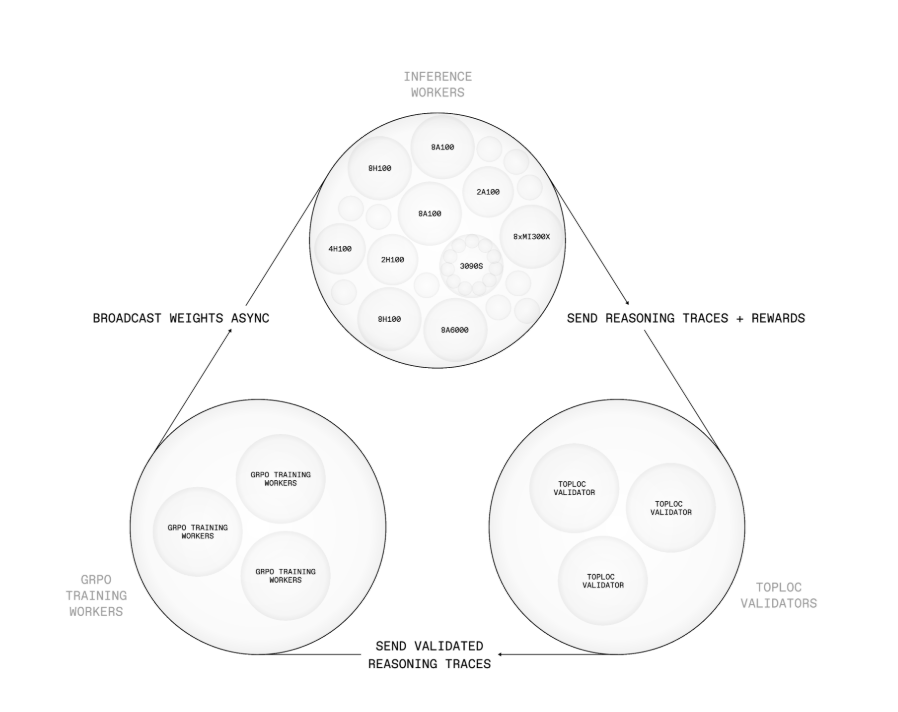
INTELLECT-2 was trained on 285,000 math and coding tasks sourced from datasets such as NuminaMath-1.5 or SYNTHETIC-1. The reward signal combines binary task success with token-length penalties or bonuses, allowing fine-grained control over inference-time compute budgets. Training stability was supported by techniques such as two-sided GRPO clipping, gradient norm management, and both offline and online filtering of high-value tasks.
The asynchronous training process overlaps inference, communication, and model updates, avoiding typical bottlenecks found in centralized RL systems. A Rust-based orchestrator running on a testnet coordinates the global pool of contributors, handling hardware checks, heartbeats, task assignments, and contribution tracking—operating similarly to peer-to-peer or blockchain-based systems.
Performance evaluations showed improvements on targeted math and programming tasks, particularly over QwQ-32B, a previous RL-trained model. Broader benchmark improvements were more modest, suggesting gains were mostly confined to training data domains. Prime Intellect noted that improvements might be more significant using stronger base models, such as Qwen3, or by integrating more complex environments and reasoning tools.
One Reddit user remarked on the broader implications:
Distributed training and distributed inference seem like the way to go. Maybe something similar to P2P or blockchain with some kind of rewards for computational contributions/transactions. Not necessarily yet another cryptocurrency, but maybe credits that can be used for free computing on the network.
Future work includes increasing the inference-to-training compute ratio, enabling multi-turn reasoning with integrated tools like web search or Python, crowdsourcing RL tasks, and experimenting with decentralized model merging methods such as DiLoCo.
The model, code, training framework, and documentation are publicly available on the Prime Intellect website. Additional tools and interfaces, including a Hugging Face release and a chat demo, are also publicly accessible.
MMS • Robert Krzaczynski

OpenAI has launched Codex, a research preview of a cloud-based software engineering agent designed to automate common development tasks such as writing code, debugging, testing, and generating pull requests. Integrated into ChatGPT for Pro, Team, and Enterprise users, Codex runs each assignment in a secure sandbox environment preloaded with the user’s codebase and configured to reflect their development setup.
Codex is powered by codex-1, a version of OpenAI’s o3 model optimized for programming tasks. It was trained using reinforcement learning on real-world examples and is capable of generating code aligned with human conventions. The model iteratively runs code and tests until a correct solution is reached. Once a task is completed, Codex commits its changes within the sandbox and provides test outputs and terminal logs for transparency.
The Codex sidebar in ChatGPT enables users to assign tasks or ask questions about their codebase through a text prompt. The model can edit files, run commands, and execute tests, with typical completion times ranging from one to thirty minutes. Codex supports AGENTS.md files—repository-level instructions that help guide the agent through project-specific practices and testing procedures.
Codex CLI, a command-line companion interface, is open source and uses API credits. However, as clarified by Fouad Matin, a member of technical staff at OpenAI, Codex access within ChatGPT is included with Pro, Team, and Enterprise subscriptions:
Codex is included in ChatGPT (Pro, Team, Enterprise) pricing with generous access for the next two weeks.
The system, however, does not yet support full application testing with live user interfaces. As one Reddit user pointed out:
Most software engineering is web development these days. How does it handle that, where you have separate layers for certain things, environment variables, and UI interfaces? Does it actually run the app so the user can test it, or do they need to push the change and then pull down a copy to test locally? That would be very annoying. Ideally, in the future, the agents can just test it themselves, but I guess they are not good enough yet.
Codex runs in an isolated container without internet access or UI execution capabilities. While it can handle test suites, linters, and type checkers, final verification and integration remain in the hands of human developers.
OpenAI has also introduced Codex mini, a lighter model designed for faster interactions and lower latency, now the default engine in Codex CLI and available via API as codex-mini-latest. It is priced at $1.50 per million input tokens and $6 per million output tokens, with a 75% prompt caching discount.
The release reflects OpenAI’s broader strategy to eventually support both real-time AI coding assistants and asynchronous agent workflows. While Codex currently connects with GitHub and is accessible from ChatGPT, OpenAI envisions deeper integrations in the future, including support for assigning tasks from Codex CLI, ChatGPT Desktop, and tools such as issue trackers or CI systems.
MMS • Robert Krzaczynski
Mistral AI has unveiled Mistral Medium 3, a mid-sized language model aimed at enterprises seeking a balance between cost-efficiency, strong performance, and flexible deployment options. The model is now available through Mistral’s platform and Amazon SageMaker, with further releases planned for IBM WatsonX, Azure AI Foundry, Google Cloud Vertex AI, and NVIDIA NIM.
According to Mistral, Medium 3 delivers performance comparable to larger models such as Claude Sonnet 3.7, reaching over 90% of its scores on internal benchmark tests, while maintaining lower cost, estimated at $0.40 per million input tokens and $2 for output. The company reports that the model surpasses open models like LLaMA 4 Maverick and outperforms commercial offerings, particularly in coding and STEM-related tasks.
Source: Mistral AI Blog
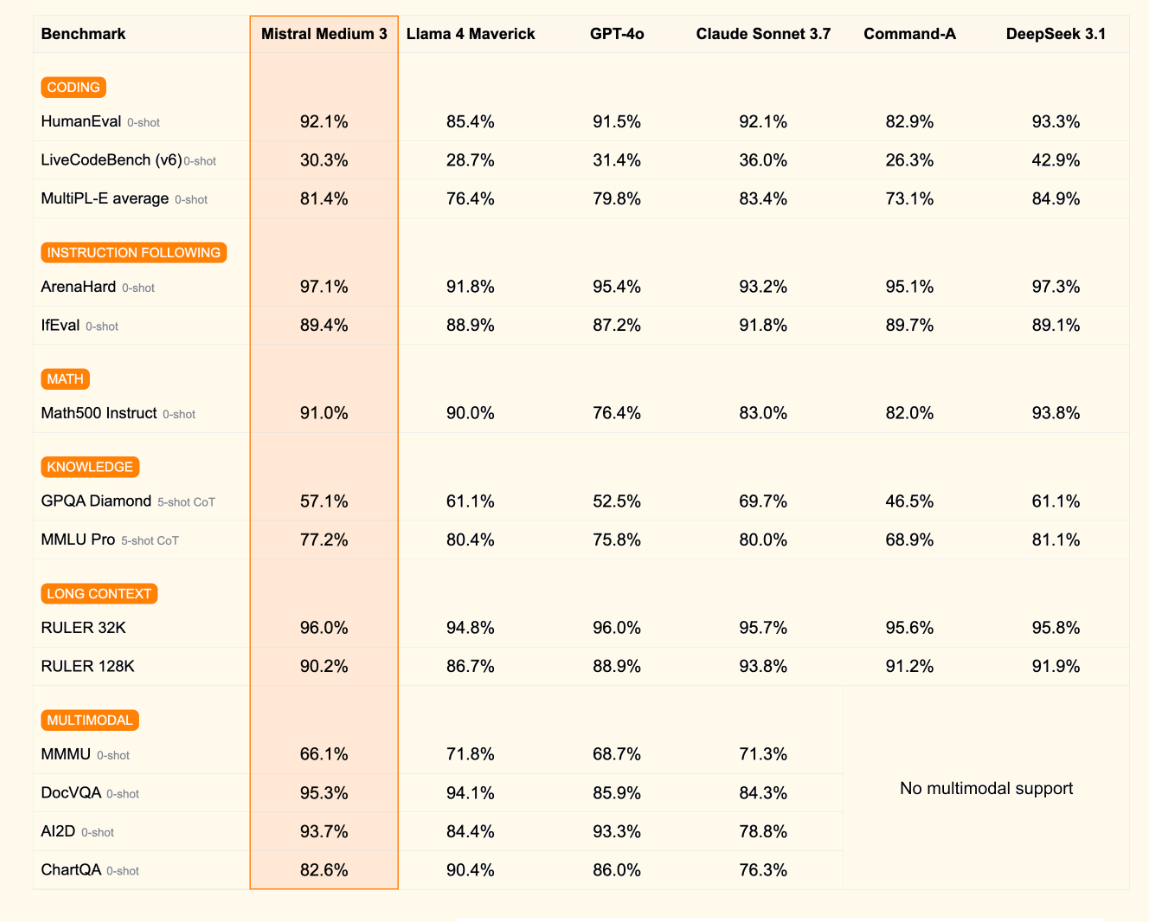
The model supports deployment in a variety of environments, including hybrid and fully on-premises configurations using systems with as few as four GPUs. It also offers customization options, including post-training, fine-tuning, and integration into private enterprise data and tools.
In real-world use cases, Mistral Medium 3 has shown promise in coding, customer support automation, and technical data analysis. The company notes early adoption in the finance, energy, and healthcare sectors, emphasizing the model’s compatibility with domain-specific applications.
Still, not all community feedback has been positive. One Reddit user commented:
It performs worse than DeepSeek models, yet its API is more expensive. And since they did not release the weights, it is unclear why anyone would pay for this.
This sentiment reflects some ongoing debate about the value of proprietary models versus open-weight alternatives, particularly in developer and research communities that prioritize transparency and fine-tuned control.
On the other hand, the model has also received support from enterprise professionals. Arnaud Bories, Sales Director Emerging at Okta, remarked:
Huge congratulations to the entire Mistral AI team on this exciting launch. The focus on enterprise-grade customization and security really stands out. At Okta, we are always exploring how identity can be a catalyst for secure and seamless AI adoption—looking forward to seeing how we might support and enhance these innovations together.
As the enterprise AI market continues to expand, Mistral Medium 3 enters a competitive space, offering a model that prioritizes deployment flexibility, cost control, and integration readiness.
MMS • Robert Krzaczynski
Researchers at Carnegie Mellon University have introduced LegoGPT, a system that generates physically stable and buildable LEGO structures from natural language descriptions. The project combines large language models with engineering constraints to produce designs that can be assembled manually or by robotic systems.
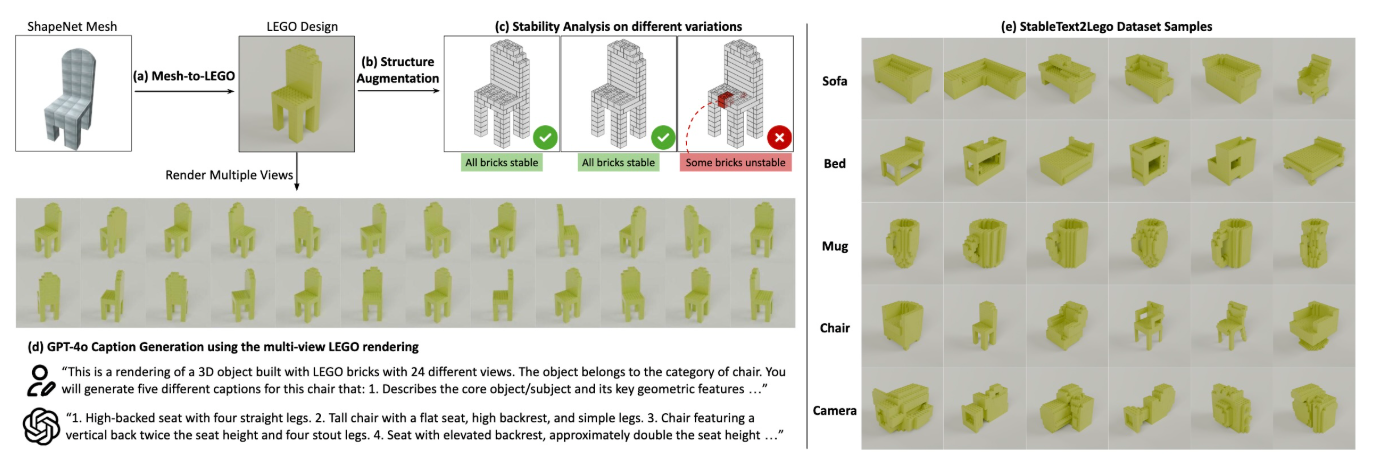
LegoGPT is trained on a new dataset called StableText2Lego, which includes over 47,000 LEGO models of more than 28,000 unique 3D objects, each paired with detailed captions. The models are derived by converting 3D meshes into voxelized LEGO representations, applying random brick layouts, and filtering unstable designs using physics simulations. Captions are generated using GPT-4o based on renderings from multiple viewpoints.
Source: https://avalovelace1.github.io/LegoGPT/
The model architecture is based on Meta’s LLaMA-3.2-1B-Instruct and fine-tuned using an instructional format that pairs LEGO brick sequences with descriptive text. At inference time, the system predicts one brick at a time in a bottom-to-top raster-scan order, applying several validation checks to ensure that each brick placement adheres to known constraints such as part existence, collision avoidance, and structural feasibility.
To handle instability during generation, LegoGPT includes a rollback mechanism. If a newly added brick leads to a physically unstable structure, the system reverts to the last stable state and continues to generate from that point. This approach is intended to produce final structures that are both prompt-aligned and mechanically sound.
Reactions from the community have been mixed. One user on Hacker News noted:
This does not seem like a very impressive result. It is using such a small set of bricks, and the results do not really look much like the intended thing. It feels like a hand-crafted algorithm would get a much better result.
In contrast, another response emphasized the methodological contribution:
But I think the cool part here is not photorealism, it is the combo of language understanding and physical buildability.
The system includes tooling for visualization and texturing using external packages like ImportLDraw and FlashTex. The team also provides scripts for fine-tuning on custom datasets and supports interactive inference through a command-line interface.
LegoGPT, along with its dataset and associated tools, is released under the MIT License. Submodules used for rendering and texturing have separate licenses. Access to some components, such as the base language model and Gurobi solver for stability analysis, may require separate agreements.
The work aims to support future research in grounded text-to-3D generation, physical reasoning, and robotics, offering a reproducible benchmark for evaluating structural soundness and prompt alignment in generative models.