Month: October 2026
Cloudflare’s Post-Quantum GeoKey Manager Enters Closed Beta without Attribute-Based Encryption

MMS • Steef-Jan Wiggers
Article originally posted on InfoQ. Visit InfoQ
Cloudflare has moved a post-quantum rebuild of GeoKey Manager into closed beta, protecting geographically fenced decryption keys with a hybrid of ML-KEM-768 and X25519 and replacing the attribute-based encryption the service has relied on since 2022. The beta opened on October 23 to existing Data Localization Suite customers, with general availability planned for the first quarter of 2027.
Chetan Agrawal, Arka Nayan and Erik Engstrom describe the redesign as addressing two requirements at once: data sovereignty rules that confine plaintext processing to a region, and harvest-now, decrypt-later attacks in which traffic captured today is decrypted once a quantum computer exists. GeoKey Manager first shipped in 2017 for TLS keys and moved to ciphertext-policy attribute-based encryption in 2022. Cloudflare gives two reasons for dropping that scheme: no production-ready post-quantum variant exists, and customers don’t need the large number of regions it was built to express.
In its place, key protection uses HPKE, the hybrid public-key encryption construction defined in RFC 9180, with a key encapsulation mechanism (KEM) combining ML-KEM-768 and X25519, HKDF-SHA-256 and AES-256-GCM. Two kinds of keys replace the policy expressions. Regional root keys are 256-bit symmetric secrets held one per region. Application-specific key pairs are derived from a root for a single service, such as Tunnel or Gateway, and a single epoch, Cloudflare’s term for a key generation that rotation advances. The key-management service derives the application key pair and wraps customer private keys under its public component.

(Source: Cloudflare blog)
The two kinds of keys travel different paths: Quicksilver, Cloudflare’s globally replicated key-value store, carries wrapped keys and metadata everywhere, while regional root keys move a separate path through the provisioning service, which stores them in Vault. Before an edge server receives a root key, it must clear three checks: TPM hardware identity verification, a lookup in Zinc, Cloudflare’s server inventory, that maps the identity to a data center and location, and a decision by the provisioning service about which roots that server may hold.
Authorized servers then load regional root keys into the kernel keyring rather than onto disk. Because that memory is volatile, “a machine restart removes the keys,” and the server has to authenticate again. Regional membership refreshes several times a day as the network changes, separately from key rotation and without customer action.

(Source: Cloudflare blog)
Dabeer Shaikh, a senior solutions engineer at HashiCorp, asked under Cloudflare’s announcement how a geo-fenced key can be rotated without downtime, and the post answers that question through its epoch model. A soft rotation creates a new epoch while a limited number of previous epochs stay usable, so customers keep uptime during the transition; a hard rotation rewraps affected keys under a replacement epoch and removes access to the previous one.
Mark Tehrani, founder of CyberSeQ and a professor of cybersecurity, posted five questions on the same thread. Four concern the blast radius of a compromised regional root key, whether a compromised Zinc inventory or provisioning service could hand regional keys to an out-of-region server, what protects keys exposed before a rotation, and whether a compromised control plane could alter regional membership. The fifth goes to the design’s central tradeoff:
If regional key provisioning, synchronization, or rotation fails, could the fail-closed design cause a region-wide service outage?
Cloudflare’s post is explicit about that behavior. Any failed check on service context, region, or epoch rejects the request, and at the edge a missing or malformed key means the service does not start. The authors call failing closed “a very intentional design choice.” The trust boundary covers the key-management, provisioning, and authorized edge key services; Quicksilver sits outside it because it only ever holds wrapped keys and metadata.
The rebuild extends a pattern in Cloudflare’s post-quantum work. As previously reported on InfoQ, Cloudflare adopted hybrid ML-KEM for its IPsec service in March, when over 60% of human-generated TLS traffic on its network already used it, and the company has since set out plans for a quantum-safe certificate authority. Most regions will be covered at launch, with product-specific caveats. What the beta will show is whether the design’s answer to a failed check, refusing to serve, is one customers accept at regional scale.
Cloudflare’s Post-Quantum GeoKey Manager Enters Closed Beta Without Attribute-Based Encryption
MMS • Steef-Jan Wiggers
Cloudflare has moved a post-quantum rebuild of GeoKey Manager into closed beta, protecting geographically fenced decryption keys with a hybrid of ML-KEM-768 and X25519 and replacing the attribute-based encryption the service has relied on since 2022. The beta opened on October 23 to existing Data Localization Suite customers, with general availability planned for the first quarter of 2027.
Chetan Agrawal, Arka Nayan and Erik Engstrom describe the redesign as addressing two requirements at once: data sovereignty rules that confine plaintext processing to a region, and harvest-now, decrypt-later attacks in which traffic captured today is decrypted once a quantum computer exists. GeoKey Manager first shipped in 2017 for TLS keys and moved to ciphertext-policy attribute-based encryption in 2022. Cloudflare gives two reasons for dropping that scheme: no production-ready post-quantum variant exists, and customers don’t need the large number of regions it was built to express.
In its place, key protection uses HPKE, the hybrid public-key encryption construction defined in RFC 9180, with a key encapsulation mechanism (KEM) combining ML-KEM-768 and X25519, HKDF-SHA-256 and AES-256-GCM. Two kinds of keys replace the policy expressions. Regional root keys are 256-bit symmetric secrets held one per region. Application-specific key pairs are derived from a root for a single service, such as Tunnel or Gateway, and a single epoch, Cloudflare’s term for a key generation that rotation advances. The key-management service derives the application key pair and wraps customer private keys under its public component.
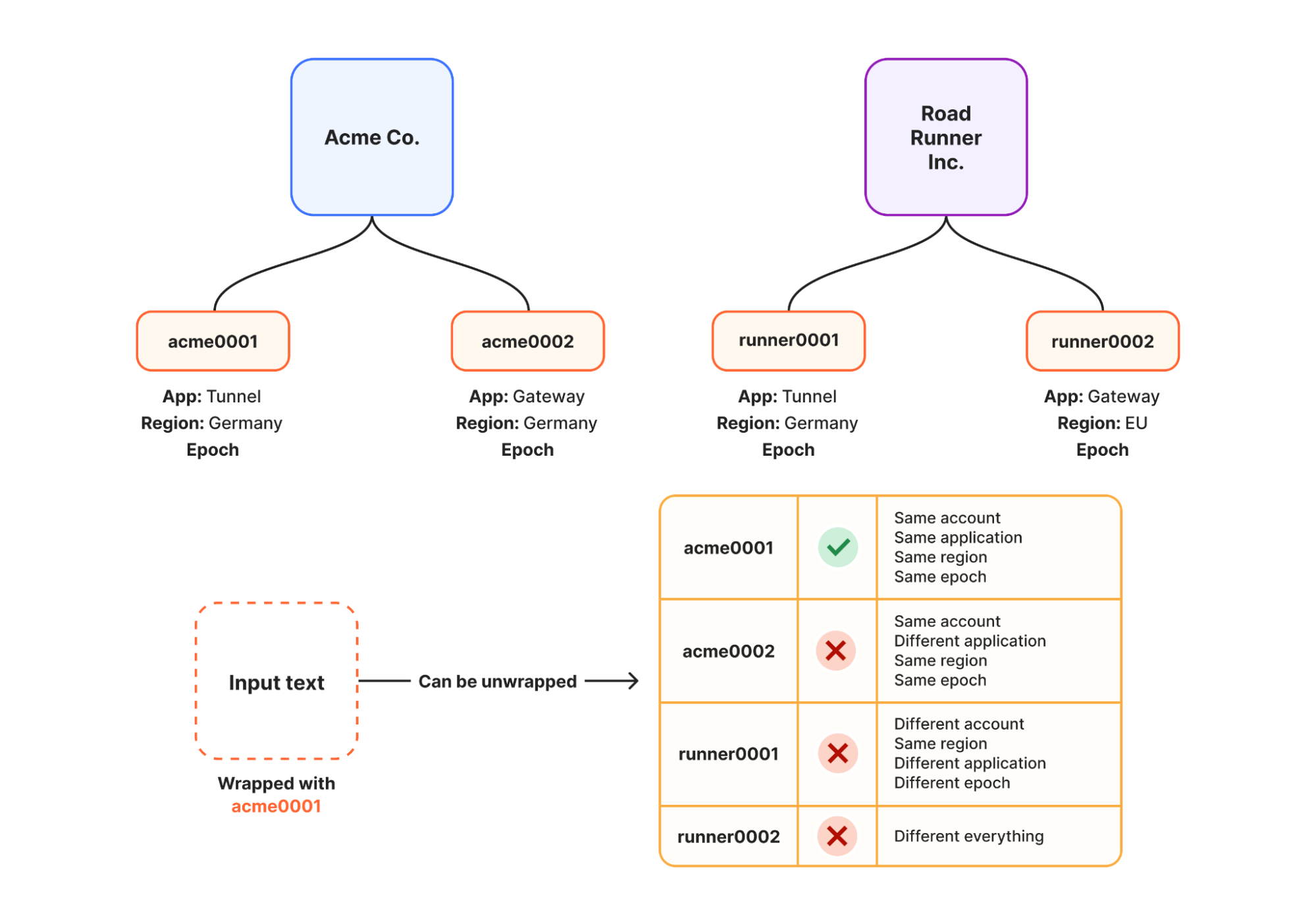
(Source: Cloudflare blog)
The two kinds of keys travel different paths: Quicksilver, Cloudflare’s globally replicated key-value store, carries wrapped keys and metadata everywhere, while regional root keys move a separate path through the provisioning service, which stores them in Vault. Before an edge server receives a root key, it must clear three checks: TPM hardware identity verification, a lookup in Zinc, Cloudflare’s server inventory, that maps the identity to a data center and location, and a decision by the provisioning service about which roots that server may hold.
Authorized servers then load regional root keys into the kernel keyring rather than onto disk. Because that memory is volatile, “a machine restart removes the keys,” and the server has to authenticate again. Regional membership refreshes several times a day as the network changes, separately from key rotation and without customer action.
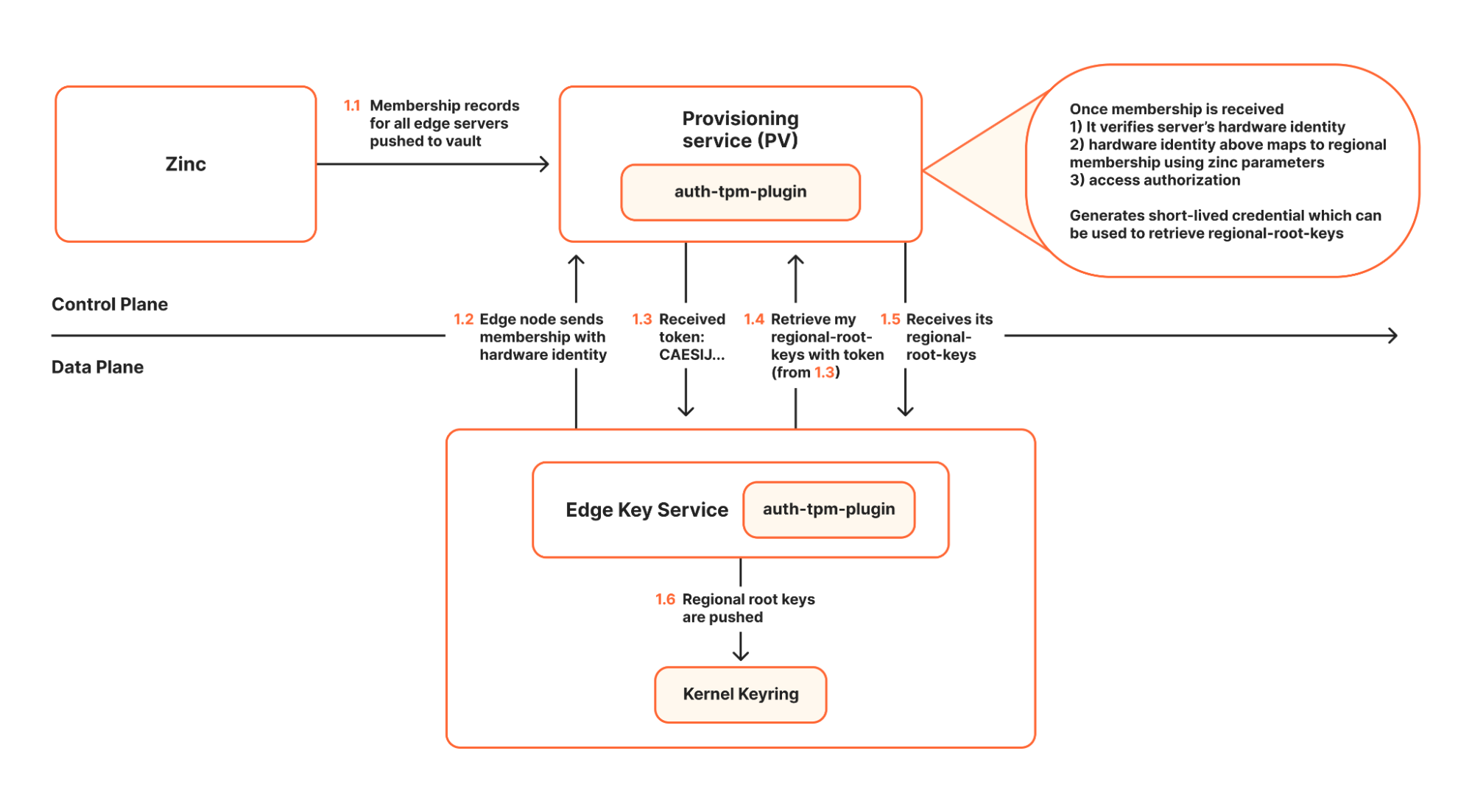
(Source: Cloudflare blog)
Dabeer Shaikh, a senior solutions engineer at HashiCorp, asked under Cloudflare’s announcement how a geo-fenced key can be rotated without downtime, and the post answers that question through its epoch model. A soft rotation creates a new epoch while a limited number of previous epochs stay usable, so customers keep uptime during the transition; a hard rotation rewraps affected keys under a replacement epoch and removes access to the previous one.
Mark Tehrani, founder of CyberSeQ and a professor of cybersecurity, posted five questions on the same thread. Four concern the blast radius of a compromised regional root key, whether a compromised Zinc inventory or provisioning service could hand regional keys to an out-of-region server, what protects keys exposed before a rotation, and whether a compromised control plane could alter regional membership. The fifth goes to the design’s central tradeoff:
If regional key provisioning, synchronization, or rotation fails, could the fail-closed design cause a region-wide service outage?
Cloudflare’s post is explicit about that behavior. Any failed check on service context, region, or epoch rejects the request, and at the edge a missing or malformed key means the service does not start. The authors call failing closed “a very intentional design choice.” The trust boundary covers the key-management, provisioning, and authorized edge key services; Quicksilver sits outside it because it only ever holds wrapped keys and metadata.
The rebuild extends a pattern in Cloudflare’s post-quantum work. As previously reported on InfoQ, Cloudflare adopted hybrid ML-KEM for its IPsec service in March, when over 60% of human-generated TLS traffic on its network already used it, and the company has since set out plans for a quantum-safe certificate authority. Most regions will be covered at launch, with product-specific caveats. What the beta will show is whether the design’s answer to a failed check, refusing to serve, is one customers accept at regional scale.
OpenBSD 8.0 Brings Expanded Hardware Support, Security Enhancements, and Virtualization Improvements
MMS • Sergio De Simone
Article originally posted on InfoQ. Visit InfoQ
OpenBSD 8.0 is a substantial upgrade bringing broader hardware compatibility, enhanced security, an expanded virtual address space, and support for modern architectures, including Intel Arc A-Series graphics support, ARM64 hibernation, RISC-V improvements, and enhanced virtual machine support.
Key hardware and virtualization improvements in OpenBSD 8.0 include a larger virtual address space for the AMD64 kernel, expanded from 4 GB to 512 GB, enabling it to map graphics cards with more than 4 GB of VRAM; support for multi-processor virtual machines through vmm/vmd, with up to 64 virtual CPUs per guest and improvements to virtual hardware and guest compatibility; expanded RISC-V support, including the ‘V’ vector extension and Advanced Interrupt Architecture, improving compatibility with newer processors and platforms; and arm64 hibernation support, alongside faster swap encryption using AES instructions.
Although OpenBSD 8.0 introduces support for the Intel Arc A-Series GPUs, based on the DG2/Alchemist architecture, NVIDIA GPUs remain unsupported, partially due to the fact that NVIDIA does not provide proprietary binary drivers for OpenBSD, unlike Linux and FreeBSD.
OpenBSD 8.0 also expands peripheral support, including the riscv64 K3 PCIe/USB3 combo PHY, the SpacemiT K3 SoC and PCIe controller, as well as the Intel E610 and Panther Lake and Wildcat Lake Ethernet devices. New drivers are now available for Samsung Advanced BIOS Interface (SABI), Rockchip OTP memory, and Samsung laptop battery monitor. Wireless adapters support has been significantly expanded as well, including support for the Qualcomm Technologies WCN7850 wireless network in the qwz driver.
The httpd daemon in OpenBSD 8.0 has received several enhancements, including support for custom HTTP headers, header block/drop rules for request filtering, improved default crypto methods for HTTPS, and cache control for static files.
On the security front, OpenBSD 8.0 continues to emphasize security as a defining priority with an outstanding track record:
We remain proud of OpenBSD’s record of more than thirty years with only two remote holes in the default install.
The new release incorporates LibreSSL 4.4.0, which introduces numerous compatibility-layer fixes for AIX, FreeBSD, macOS, MinGW, NetBSD, and especially Windows, alongside various internal improvements. It also brings OpenSSH 10.6, which disables SSH Compression using LZ77 and rejects $ and characters in command-line usernames to mitigate potential shell injection vulnerabilities, among other enhancements.
A Hacker News thread about the new release highlighted several important aspects of OpenBSD. User ctolsen emphasized the system’s simplicity and its adherence to traditional Unix philosophy:
OpenBSD just feels like a *nix system is supposed to.
ps auxis like 10 entries at first.pfmakes so much sense.manpages are consistently incredible. The security/cryptography focus, managing services, pledge/unveil…
Longtime OpenBSD user nanolith, who has used the system for nearly 20 years, praised its stability and consistency across upgrades, noting that “it’s so stable that I barely notice changes when I upgrade until I go hunting for them”. However, he also points out that OpenBSD might not be the best choice for large servers, given its lack of support for advanced filesystems like ZFS, Btrfs, or GeFS.
OpenBSD 8.0 Brings Expanded Hardware Support, Security Enhancements, and Virtualization Improvements
MMS • Sergio De Simone

OpenBSD 8.0 is a substantial upgrade bringing broader hardware compatibility, enhanced security, an expanded virtual address space, and support for modern architectures, including Intel Arc A-Series graphics support, ARM64 hibernation, RISC-V improvements, and enhanced virtual machine support.
Key hardware and virtualization improvements in OpenBSD 8.0 include a larger virtual address space for the AMD64 kernel, expanded from 4 GB to 512 GB, enabling it to map graphics cards with more than 4 GB of VRAM; support for multi-processor virtual machines through vmm/vmd, with up to 64 virtual CPUs per guest and improvements to virtual hardware and guest compatibility; expanded RISC-V support, including the ‘V’ vector extension and Advanced Interrupt Architecture, improving compatibility with newer processors and platforms; and arm64 hibernation support, alongside faster swap encryption using AES instructions.
Although OpenBSD 8.0 introduces support for the Intel Arc A-Series GPUs, based on the DG2/Alchemist architecture, NVIDIA GPUs remain unsupported, partially due to the fact that NVIDIA does not provide proprietary binary drivers for OpenBSD, unlike Linux and FreeBSD.
OpenBSD 8.0 also expands peripheral support, including the riscv64 K3 PCIe/USB3 combo PHY, the SpacemiT K3 SoC and PCIe controller, as well as the Intel E610 and Panther Lake and Wildcat Lake Ethernet devices. New drivers are now available for Samsung Advanced BIOS Interface (SABI), Rockchip OTP memory, and Samsung laptop battery monitor. Wireless adapters support has been significantly expanded as well, including support for the Qualcomm Technologies WCN7850 wireless network in the qwz driver.
The httpd daemon in OpenBSD 8.0 has received several enhancements, including support for custom HTTP headers, header block/drop rules for request filtering, improved default crypto methods for HTTPS, and cache control for static files.
On the security front, OpenBSD 8.0 continues to emphasize security as a defining priority with an outstanding track record:
We remain proud of OpenBSD’s record of more than thirty years with only two remote holes in the default install.
The new release incorporates LibreSSL 4.4.0, which introduces numerous compatibility-layer fixes for AIX, FreeBSD, macOS, MinGW, NetBSD, and especially Windows, alongside various internal improvements. It also brings OpenSSH 10.6, which disables SSH Compression using LZ77 and rejects $ and characters in command-line usernames to mitigate potential shell injection vulnerabilities, among other enhancements.
A Hacker News thread about the new release highlighted several important aspects of OpenBSD. User ctolsen emphasized the system’s simplicity and its adherence to traditional Unix philosophy:
OpenBSD just feels like a *nix system is supposed to.
ps auxis like 10 entries at first.pfmakes so much sense.manpages are consistently incredible. The security/cryptography focus, managing services, pledge/unveil…
Longtime OpenBSD user nanolith, who has used the system for nearly 20 years, praised its stability and consistency across upgrades, noting that “it’s so stable that I barely notice changes when I upgrade until I go hunting for them”. However, he also points out that OpenBSD might not be the best choice for large servers, given its lack of support for advanced filesystems like ZFS, Btrfs, or GeFS.
Spring News Roundup: First Release Candidates of Boot, Framework, Data, Security, Modulith, AI
MMS • Michael Redlich
Article originally posted on InfoQ. Visit InfoQ
There was a flurry of activity during the week of October 19th, 2026, highlighting: first release candidates of: Spring Boot, Spring Framework, Spring Data, Spring Cloud, Spring Security, Spring for GraphQL, Spring Session, Spring Integration, Spring HATEOS, Spring Modulith, Spring REST Docs, Spring AI, Spring Batch, Spring AMQP, Spring for Apache Kafka, Spring LDAP and Spring Web Services.
Spring Boot
The first release candidate of Spring Boot 4.2.0 delivers bug fixes, documentation improvements, dependency upgrades and new features such as: a migration to the Ubuntu Resolute builder replacing the Noble Java Tiny Builder; and improved Uber-Jar performance using direct lookup of classes and resources in nested jars. More details on this release may be found in the release notes and this wiki page.
Spring Framework
The first release candidate of Spring Framework 7.1.0 ships with bug fixes, dependency upgrades and new features such as: improved nullability in the DataAccessUtils and LinkedCaseInsensitiveMap classes; and new overloaded methods, onRetrySuccess() and onRetryFailure(), defined in the RetryListener interface, that add an instance of the RetryState class in the parameter list such that listeners can access the retry state directly upon failure. Further details on this release, including removal of deprecated APIs, may be found in the release notes.
Spring Data
The first release candidate of Spring Data 2026.1.0 provides bug fixes, dependency upgrades, RC1 upgrades to all of the subprojects and a notable new feature in Spring Data Redis that now forwards subscription notifications related to annotated listener methods if a bean implements the SubscriptionListener interface.
Spring Cloud
The first release candidate of Spring Cloud 2026.0.0, codenamed Paddington, delivers dependency upgrades, RC1 upgrades to all of the subprojects and a notable change where Spring Cloud Bus is no longer its own project and has been incorporated into Spring Cloud Stream. This release is based on Spring Boot 4.2.0-RC1. More details on this release may be found in this release notes.
Spring Security
The first release candidate of Spring Security 7.2.0 ships with bug fixes, dependency upgrades and two new features: an instance of the StrictServerWebExchangeFirewall class no longer detects a non-canonical-case HTTP method as a distinct value due to a change in the valueOf() method, defined in the Spring Framework HttpMethod class, that now normalizes casing; and RestClientOpaqueTokenIntrospector and SpringOpaqueTokenIntrospector classes now set the Content-Type header to application/x-www-form-urlencoded. Further details on this release may be found in the release notes and this what’s new page.
Spring for GraphQL
The first release candidate of Spring for GraphQL 2.1.0 provides one bug fix that reinstates the Content-Length response header for WebFlux applications so that backwards compatibility is maintained and notable dependency upgrades such as: Spring Framework 7.1.0-RC1; Spring Data 2026.1.0-RC1; and Spring Security 7.2.0-RC1. More details on this release may be found in the release notes.
Spring Session
The first release candidate of Spring Session 4.2.0 delivers bug fixes, dependency upgrades and new features such as: integrating the Spring Security Settings Plugin and Spring Security Maven Plugin; and standardizing the configuration of the public and private continuous integration environments. Further details on this release may be found in the release notes.
Spring Integration
The first release candidate of Spring Integration 7.2.0 ships with bug fixes, documentation improvements, dependency upgrades and new features such as: a deprecation of the default constructor in the SerializingHttpMessageConverter class to define a new constructor that contains the allowedPatterns attribute for improved security; and the ability to allow the DefaultJmsHeaderMapper class to set the outboundHeaderNames, inboundHeaderNames and excludedOutboundStandardRequestHeaderNames and excludedInboundStandardResponseHeaderNames to align with the DefaultHttpHeaderMapper class. More details on this release may be found in the release notes.
Spring HATEOAS
The first release candidate of Spring HATEOAS 3.2.0 provides notable dependency upgrades such as: Spring Framework 7.1.0-RC1; Spring Plugin 4.2.0-RC1; and Reactor 2026.0.0-RC1. Further details on this release may be found in the release notes.
Spring Modulith
The first release candidate of Spring Modulith 2.2.0 delivers bug fixes, dependency upgrades and new features such as: new ABANDONED and RESUBMITTED enumerations, added to the EventPublication.Status interface, to distinguish between failed and abandoned event publications; and event publications are now completed, by default, using the Spring Framework TransactionSynchronization interface within a listener’s transaction to avoid the possibility of a listener committing and the completion to fail. More details on this release may be found in the release notes.
Spring REST Docs
The first release candidate of Spring REST Docs 4.1.0 ships with one bug fix, a dependency upgrade to Spring Framework 7.1.0-RC1 and new features such as: improved nullability using JSpecify; and support for using the Spring Framework RestTestClient interface. Further details on this release may be found in the release notes.
Spring AI
The first release candidate of Spring AI 2.1.0 provides dependency upgrades and new features such as: a new SessionService interface for creating and finding sessions that replaces the now-deprecated ChatMemory interface; and the ability for the OpenAiChatModel and DeepSeekChatModel classes to build an assistant message of each choice from ordered message parts. More details on this release may be found in the release notes.
Spring Batch
The first release candidate of Spring Batch 6.1.0 delivers bug fixes, documentation improvements, dependency upgrades and new features such as: a new @JobParameter annotation that injects a job parameter into a job or step scoped bean used to require a Spring Expression Language (SpEL) expression; and a new PageableItemReader class that serves as a type-safe alternative to RepositoryItemReader class to take a function from the Spring Data Pageable interface to a Slice interface. Further details on this release may be found in the release notes.
Spring AMQP
The first release candidate of Spring AMQP 4.2.0 ships with bug fixes, documentation improvements, dependency upgrades and new features such as: removal of the use of the noNullElements() method, defined in the Spring Framework Assert class, to allow the RabbitAdmin class and AmqpAdmin interface to accept null or empty arrays when declaring exchanges, queues, and bindings; and a simplification of the buildMessage() method, defined in both the AbstractAdaptableMessageListener and MessagingMessageListenerAdapter classes, to avoid unnecessary nesting when handling existing instances of the Message class and message conversion. More details on this release may be found in the release notes.
Spring for Apache Kafka
The first release candidate of Spring for Apache Kafka 4.2.0 provides bug fixes, documentation improvements, dependency upgrades and one new feature that now writes out the value defined in the KafkaHeaders.DELIVERY_ATTEMPT header when using the CommonDelegatingErrorHandler class in conjunction with the deliveryAttemptHeader container property set to true. Further details on this release may be found in the release notes.
Spring LDAP
The first release candidate of Spring LDAP 4.2.0 delivers bug fixes, dependency upgrades and new features such as: use of string parameterization in logging to avoid non-constant filename lengths; the addition of test cases for the DefaultObjectDirectoryMapperTests class; and string cleanup in the getStringAttribute() method, defined in DirContextAdapter class, to prevent a ClassCastException. More details on this release, including breaking changes, may be found in the release notes and what’s new page.
Spring Web Services
The first release candidate of Spring Web Services 5.1.0 ships with documentation improvements dependency upgrades and one new feature that allows an instance of the DefaultWsdl11Definition class to attach a policy document, such as a WS-Policy or WS-SecurityPolicy fragment, to every binding it generates. Further details on this release may be found in the release notes and this wiki page.
Spring News Roundup: First Release Candidates of Boot, Framework, Data, Security, Modulith, AI
MMS • Michael Redlich

There was a flurry of activity during the week of October 19th, 2026, highlighting: first release candidates of: Spring Boot, Spring Framework, Spring Data, Spring Cloud, Spring Security, Spring for GraphQL, Spring Session, Spring Integration, Spring HATEOS, Spring Modulith, Spring REST Docs, Spring AI, Spring Batch, Spring AMQP, Spring for Apache Kafka, Spring LDAP and Spring Web Services.
Spring Boot
The first release candidate of Spring Boot 4.2.0 delivers bug fixes, documentation improvements, dependency upgrades and new features such as: a migration to the Ubuntu Resolute builder replacing the Noble Java Tiny Builder; and improved Uber-Jar performance using direct lookup of classes and resources in nested jars. More details on this release may be found in the release notes and this wiki page.
Spring Framework
The first release candidate of Spring Framework 7.1.0 ships with bug fixes, dependency upgrades and new features such as: improved nullability in the DataAccessUtils and LinkedCaseInsensitiveMap classes; and new overloaded methods, onRetrySuccess() and onRetryFailure(), defined in the RetryListener interface, that add an instance of the RetryState class in the parameter list such that listeners can access the retry state directly upon failure. Further details on this release, including removal of deprecated APIs, may be found in the release notes.
Spring Data
The first release candidate of Spring Data 2026.1.0 provides bug fixes, dependency upgrades, RC1 upgrades to all of the subprojects and a notable new feature in Spring Data Redis that now forwards subscription notifications related to annotated listener methods if a bean implements the SubscriptionListener interface.
Spring Cloud
The first release candidate of Spring Cloud 2026.0.0, codenamed Paddington, delivers dependency upgrades, RC1 upgrades to all of the subprojects and a notable change where Spring Cloud Bus is no longer its own project and has been incorporated into Spring Cloud Stream. This release is based on Spring Boot 4.2.0-RC1. More details on this release may be found in this release notes.
Spring Security
The first release candidate of Spring Security 7.2.0 ships with bug fixes, dependency upgrades and two new features: an instance of the StrictServerWebExchangeFirewall class no longer detects a non-canonical-case HTTP method as a distinct value due to a change in the valueOf() method, defined in the Spring Framework HttpMethod class, that now normalizes casing; and RestClientOpaqueTokenIntrospector and SpringOpaqueTokenIntrospector classes now set the Content-Type header to application/x-www-form-urlencoded. Further details on this release may be found in the release notes and this what’s new page.
Spring for GraphQL
The first release candidate of Spring for GraphQL 2.1.0 provides one bug fix that reinstates the Content-Length response header for WebFlux applications so that backwards compatibility is maintained and notable dependency upgrades such as: Spring Framework 7.1.0-RC1; Spring Data 2026.1.0-RC1; and Spring Security 7.2.0-RC1. More details on this release may be found in the release notes.
Spring Session
The first release candidate of Spring Session 4.2.0 delivers bug fixes, dependency upgrades and new features such as: integrating the Spring Security Settings Plugin and Spring Security Maven Plugin; and standardizing the configuration of the public and private continuous integration environments. Further details on this release may be found in the release notes.
Spring Integration
The first release candidate of Spring Integration 7.2.0 ships with bug fixes, documentation improvements, dependency upgrades and new features such as: a deprecation of the default constructor in the SerializingHttpMessageConverter class to define a new constructor that contains the allowedPatterns attribute for improved security; and the ability to allow the DefaultJmsHeaderMapper class to set the outboundHeaderNames, inboundHeaderNames and excludedOutboundStandardRequestHeaderNames and excludedInboundStandardResponseHeaderNames to align with the DefaultHttpHeaderMapper class. More details on this release may be found in the release notes.
Spring HATEOAS
The first release candidate of Spring HATEOAS 3.2.0 provides notable dependency upgrades such as: Spring Framework 7.1.0-RC1; Spring Plugin 4.2.0-RC1; and Reactor 2026.0.0-RC1. Further details on this release may be found in the release notes.
Spring Modulith
The first release candidate of Spring Modulith 2.2.0 delivers bug fixes, dependency upgrades and new features such as: new ABANDONED and RESUBMITTED enumerations, added to the EventPublication.Status interface, to distinguish between failed and abandoned event publications; and event publications are now completed, by default, using the Spring Framework TransactionSynchronization interface within a listener’s transaction to avoid the possibility of a listener committing and the completion to fail. More details on this release may be found in the release notes.
Spring REST Docs
The first release candidate of Spring REST Docs 4.1.0 ships with one bug fix, a dependency upgrade to Spring Framework 7.1.0-RC1 and new features such as: improved nullability using JSpecify; and support for using the Spring Framework RestTestClient interface. Further details on this release may be found in the release notes.
Spring AI
The first release candidate of Spring AI 2.1.0 provides dependency upgrades and new features such as: a new SessionService interface for creating and finding sessions that replaces the now-deprecated ChatMemory interface; and the ability for the OpenAiChatModel and DeepSeekChatModel classes to build an assistant message of each choice from ordered message parts. More details on this release may be found in the release notes.
Spring Batch
The first release candidate of Spring Batch 6.1.0 delivers bug fixes, documentation improvements, dependency upgrades and new features such as: a new @JobParameter annotation that injects a job parameter into a job or step scoped bean used to require a Spring Expression Language (SpEL) expression; and a new PageableItemReader class that serves as a type-safe alternative to RepositoryItemReader class to take a function from the Spring Data Pageable interface to a Slice interface. Further details on this release may be found in the release notes.
Spring AMQP
The first release candidate of Spring AMQP 4.2.0 ships with bug fixes, documentation improvements, dependency upgrades and new features such as: removal of the use of the noNullElements() method, defined in the Spring Framework Assert class, to allow the RabbitAdmin class and AmqpAdmin interface to accept null or empty arrays when declaring exchanges, queues, and bindings; and a simplification of the buildMessage() method, defined in both the AbstractAdaptableMessageListener and MessagingMessageListenerAdapter classes, to avoid unnecessary nesting when handling existing instances of the Message class and message conversion. More details on this release may be found in the release notes.
Spring for Apache Kafka
The first release candidate of Spring for Apache Kafka 4.2.0 provides bug fixes, documentation improvements, dependency upgrades and one new feature that now writes out the value defined in the KafkaHeaders.DELIVERY_ATTEMPT header when using the CommonDelegatingErrorHandler class in conjunction with the deliveryAttemptHeader container property set to true. Further details on this release may be found in the release notes.
Spring LDAP
The first release candidate of Spring LDAP 4.2.0 delivers bug fixes, dependency upgrades and new features such as: use of string parameterization in logging to avoid non-constant filename lengths; the addition of test cases for the DefaultObjectDirectoryMapperTests class; and string cleanup in the getStringAttribute() method, defined in DirContextAdapter class, to prevent a ClassCastException. More details on this release, including breaking changes, may be found in the release notes and what’s new page.
Spring Web Services
The first release candidate of Spring Web Services 5.1.0 ships with documentation improvements dependency upgrades and one new feature that allows an instance of the DefaultWsdl11Definition class to attach a policy document, such as a WS-Policy or WS-SecurityPolicy fragment, to every binding it generates. Further details on this release may be found in the release notes and this wiki page.
MMS • Mark Silvester
Article originally posted on InfoQ. Visit InfoQ
Fortanix has announced support for Confidential Containers in its Confidential AI platform. The integration connects Kubernetes workload attestation to encryption-key release, so workloads that meet security policy can decrypt models and sensitive data inside hardware-based trusted execution environments (TEEs).
Confidential Containers (CoCo), a Cloud Native Computing Foundation project, runs Kubernetes pods inside confidential virtual machines backed by hardware-based trusted execution environments (TEEs). Unlike ordinary containers, whose isolation depends largely on the host operating system, confidential VMs use hardware protections to encrypt memory and restrict access to the workload while it runs. This helps protect data in use, not just data at rest or in transit, and can let teams run sensitive workloads on shared infrastructure. Those protections still depend on trusting the guest software and configuring attestation and key release correctly.
Fortanix’s technical overview describes plugins connecting CoCo workloads to two services: Confidential Computing Manager (CCM), which verifies the environment, and Data Security Manager (DSM), which releases keys only to environments CCM has verified. The company says CCM can attest the processor and graphics processing unit (GPU) together, a check that depends on configuration.
CoCo moves image pulling and unpacking into the confidential guest. Its Attestation Agent collects hardware evidence, and its Confidential Data Hub obtains secrets after verification. In Fortanix’s described workflow, keys stay in DSM if attestation fails, so the workload cannot decrypt protected models or data.
Fortanix chief product officer Anuj Jaiswal said in the announcement: “With attestation and key management in one platform, teams can adopt standard CoCo without building the trust layer themselves.” Fortanix says CCM and DSM run clustered, with 24×7 support, as a hosted service, on-premises or air-gapped.
Fortanix’s Intel TDX deployment guide offers two GPU settings: Required makes CCM validate GPU evidence through NVIDIA’s attestation service; Ignored checks only that evidence is present and disregards the result. The guide also notes that the Fortanix CoCo Helm chart does not configure host firmware or kernel settings, which must be completed beforehand.
Attestation and conditional secret delivery already exist in CoCo’s open-source Trustee components. Trustee separates evidence appraisal from resource authorisation. Its attestation service compares platform claims with reference values, then its Key Broker Service applies a user-defined policy before releasing secrets from local storage, a plugin or an external key store. A successful attestation still requires that policy to authorise the request. Trustee also accepts GPU evidence bound to the processor’s attestation report.
Microsoft’s Azure Secure Key Release offers a managed alternative in Key Vault Premium and Managed HSM, integrated with Azure Attestation. It releases exportable keys, not secrets or certificates.
The pod’s guest kernel and helper processes sit inside the trust boundary, so teams must trust them too. CoCo’s trust model explains that hardware measurements usually cover the guest environment, with container verification forming a separate stage. It also warns that an enclave application can still expose a dangerous external interface and excludes denial-of-service protection and hardware side channels. Attestation does not establish that an AI application handles data safely.
Fortanix says CoCo support is available now, and its deployment guide documents installing the Fortanix CoCo Helm chart. The announcement also says Fortanix is developing open-source plugins for CoCo, without naming repositories or versions. CCM’s 17 September release notes added CoCo application registration for AMD Secure Encrypted Virtualization-Secure Nested Paging (SEV-SNP) and Intel Trust Domain Extensions (TDX).
LocalStack for Azure Enters Public Preview with Security Settings Stored but Not Enforced
MMS • Steef-Jan Wiggers
Article originally posted on InfoQ. Visit InfoQ
LocalStack has put its Azure emulator into public preview, free and self-serve, with general availability expected in early 2027. Its own documentation is candid about the gap between emulating a resource and emulating its behavior.
The product runs Azure services on a developer machine and accepts existing ARM and Bicep templates, Terraform modules, Pulumi programs, and Azure CLI scripts without rewrites. The pitch is to test applications, as LocalStack puts it, “without waiting on a dev subscription or paying for every iteration.” The service list is broad, covering AKS, Container Apps, Functions, App Service, Cosmos DB, Service Bus, Event Hubs, Key Vault, App Configuration, Managed Identity, API Management and more, and is wider than the announcement itself suggests. Each developer gets an isolated sandbox, and LocalStack positions it for development and testing rather than as a replacement for Azure.
The project is led by Paolo Salvatori, a Microsoft principal who spent 28 years at the company before joining LocalStack, and the creator of Service Bus Explorer. He sets the fidelity contract in one line:
If your solution runs perfectly on Azure but fails on our emulator, that is our bug to fix.
The documentation covers 24 resource providers and reports how much of each API is implemented. Storage Accounts covers 13 of 81 operations. App Service covers 143 of 616. Virtual Network covers 10 of 29.
The more useful pattern is what happens to the operations that are implemented. Configuration is frequently accepted, stored, and returned without taking effect. On App Service:
Keys, access restrictions, authentication settings, and publishing credential policies are not enforced.
The same page records that httpsOnly is not enforced and the emulator serves HTTP, that custom host-name bindings are stored and listed while the app answers only on its default names, that VNet integration is stored and returned with no network effect, and that backup configuration is stored while backup and restore are not implemented.
Networking follows suit. The Virtual Network page states plainly that “the emulator does not route network traffic or enforce security rules,” that peering is unsupported, and that VPN gateways, ExpressRoute circuits, Load Balancer, Application Gateway, and Network Watcher are not implemented. Private DNS zones accept only A records.
Several Storage divergences land on authentication. Data-plane requests with a bearer token succeed whenever a token is present unless RBAC enforcement is enabled. A user delegation SAS does not re-check the principal’s RBAC when used. A SAS restricted to the caller’s public IP is refused because the emulator sees a Docker or loopback address. Unsupported request headers are silently accepted rather than rejected, and the x-ms-version header is not validated at all.
That promise is about code that runs in Azure and fails locally. The documented gaps mostly describe the reverse: an app with httpsOnly set serves HTTP here, and a data-plane request carrying any bearer token gets through. Both pass locally, and nothing in the run flags the difference.
Three behaviors will surprise people before any of that does. A web app created on a Windows plan runs its code in the Linux runtime. The Oryx build image ships for amd64 only, so on Apple Silicon a code deployment’s build fails, and the app starts without its dependencies. App Service state is held in memory and lost when the emulator stops.
Microsoft’s own local tooling is narrower and older. Azurite emulates Blob, Queue, and Table storage, the Cosmos DB emulator covers that database, and Azure Functions Core Tools runs Functions locally. None compose into a single environment where an ARM or Bicep deployment can be exercised end to end, which is the gap LocalStack aims to fill.
LocalStack also pitches the sandbox at AI agents, somewhere they can “deploy, break, and retry” without live credentials. An agent iterating there gets access restrictions stored rather than applied, and any bearer token accepted. Both come back as passes.
Developer experience features, including App Inspector, snapshots, and the chaos APIs, are not in preview. Pricing arrives at general availability, and preview access ends there. The transition terms are not settled: the product page still carries “[30 days]” as a literal placeholder and an unfilled next-steps section.
MMS • Mark Silvester

Fortanix has announced support for Confidential Containers in its Confidential AI platform. The integration connects Kubernetes workload attestation to encryption-key release, so workloads that meet security policy can decrypt models and sensitive data inside hardware-based trusted execution environments (TEEs).
Confidential Containers (CoCo), a Cloud Native Computing Foundation project, runs Kubernetes pods inside confidential virtual machines backed by hardware-based trusted execution environments (TEEs). Unlike ordinary containers, whose isolation depends largely on the host operating system, confidential VMs use hardware protections to encrypt memory and restrict access to the workload while it runs. This helps protect data in use, not just data at rest or in transit, and can let teams run sensitive workloads on shared infrastructure. Those protections still depend on trusting the guest software and configuring attestation and key release correctly.
Fortanix’s technical overview describes plugins connecting CoCo workloads to two services: Confidential Computing Manager (CCM), which verifies the environment, and Data Security Manager (DSM), which releases keys only to environments CCM has verified. The company says CCM can attest the processor and graphics processing unit (GPU) together, a check that depends on configuration.
CoCo moves image pulling and unpacking into the confidential guest. Its Attestation Agent collects hardware evidence, and its Confidential Data Hub obtains secrets after verification. In Fortanix’s described workflow, keys stay in DSM if attestation fails, so the workload cannot decrypt protected models or data.
Fortanix chief product officer Anuj Jaiswal said in the announcement: “With attestation and key management in one platform, teams can adopt standard CoCo without building the trust layer themselves.” Fortanix says CCM and DSM run clustered, with 24×7 support, as a hosted service, on-premises or air-gapped.
Fortanix’s Intel TDX deployment guide offers two GPU settings: Required makes CCM validate GPU evidence through NVIDIA’s attestation service; Ignored checks only that evidence is present and disregards the result. The guide also notes that the Fortanix CoCo Helm chart does not configure host firmware or kernel settings, which must be completed beforehand.
Attestation and conditional secret delivery already exist in CoCo’s open-source Trustee components. Trustee separates evidence appraisal from resource authorisation. Its attestation service compares platform claims with reference values, then its Key Broker Service applies a user-defined policy before releasing secrets from local storage, a plugin or an external key store. A successful attestation still requires that policy to authorise the request. Trustee also accepts GPU evidence bound to the processor’s attestation report.
Microsoft’s Azure Secure Key Release offers a managed alternative in Key Vault Premium and Managed HSM, integrated with Azure Attestation. It releases exportable keys, not secrets or certificates.
The pod’s guest kernel and helper processes sit inside the trust boundary, so teams must trust them too. CoCo’s trust model explains that hardware measurements usually cover the guest environment, with container verification forming a separate stage. It also warns that an enclave application can still expose a dangerous external interface and excludes denial-of-service protection and hardware side channels. Attestation does not establish that an AI application handles data safely.
Fortanix says CoCo support is available now, and its deployment guide documents installing the Fortanix CoCo Helm chart. The announcement also says Fortanix is developing open-source plugins for CoCo, without naming repositories or versions. CCM’s 17 September release notes added CoCo application registration for AMD Secure Encrypted Virtualization-Secure Nested Paging (SEV-SNP) and Intel Trust Domain Extensions (TDX).
LocalStack for Azure Enters Public Preview with Security Settings Stored but Not Enforced
MMS • Steef-Jan Wiggers

LocalStack has put its Azure emulator into public preview, free and self-serve, with general availability expected in early 2027. Its own documentation is candid about the gap between emulating a resource and emulating its behavior.
The product runs Azure services on a developer machine and accepts existing ARM and Bicep templates, Terraform modules, Pulumi programs, and Azure CLI scripts without rewrites. The pitch is to test applications, as LocalStack puts it, “without waiting on a dev subscription or paying for every iteration.” The service list is broad, covering AKS, Container Apps, Functions, App Service, Cosmos DB, Service Bus, Event Hubs, Key Vault, App Configuration, Managed Identity, API Management and more, and is wider than the announcement itself suggests. Each developer gets an isolated sandbox, and LocalStack positions it for development and testing rather than as a replacement for Azure.
The project is led by Paolo Salvatori, a Microsoft principal for 28 years before joining LocalStack and the creator of Service Bus Explorer. He sets the fidelity contract in one line:
If your solution runs perfectly on Azure but fails on our emulator, that is our bug to fix.
The documentation covers 24 resource providers and reports how much of each API is implemented. Storage Accounts covers 13 of 81 operations. App Service covers 143 of 616. Virtual Network covers 10 of 29.
The more useful pattern is what happens to the operations that are implemented. Configuration is frequently accepted, stored, and returned without taking effect. On App Service:
Keys, access restrictions, authentication settings, and publishing credential policies are not enforced.
The same page records that httpsOnly is not enforced and the emulator serves HTTP, that custom host-name bindings are stored and listed while the app answers only on its default names, that VNet integration is stored and returned with no network effect, and that backup configuration is stored while backup and restore are not implemented.
Networking follows suit. The Virtual Network page states plainly that “the emulator does not route network traffic or enforce security rules,” that peering is unsupported, and that VPN gateways, ExpressRoute circuits, Load Balancer, Application Gateway, and Network Watcher are not implemented. Private DNS zones accept only A records.
Several Storage divergences land on authentication. Data-plane requests with a bearer token succeed whenever a token is present unless RBAC enforcement is enabled. A user delegation SAS does not re-check the principal’s RBAC when used. A SAS restricted to the caller’s public IP is refused because the emulator sees a Docker or loopback address. Unsupported request headers are silently accepted rather than rejected, and the x-ms-version header is not validated at all.
That promise is about code that runs in Azure and fails locally. The documented gaps mostly describe the reverse: an app with httpsOnly set serves HTTP here, and a data-plane request carrying any bearer token gets through. Both pass locally, and nothing in the run flags the difference.
Three behaviors will surprise people before any of that does. A web app created on a Windows plan runs its code in the Linux runtime. The Oryx build image ships for amd64 only, so on Apple Silicon a code deployment’s build fails, and the app starts without its dependencies. App Service state is held in memory and lost when the emulator stops.
Microsoft’s own local tooling is narrower and older. Azurite emulates Blob, Queue, and Table storage, the Cosmos DB emulator covers that database, and Azure Functions Core Tools runs Functions locally. None compose into a single environment where an ARM or Bicep deployment can be exercised end to end, which is the gap LocalStack aims to fill.
LocalStack also pitches the sandbox at AI agents, somewhere they can “deploy, break, and retry” without live credentials. An agent iterating there gets access restrictions stored rather than applied, and any bearer token accepted. Both come back as passes.
Developer experience features, including App Inspector, snapshots, and the chaos APIs, are not in preview. Pricing arrives at general availability, and preview access ends there. The transition terms are not settled: the product page still carries “[30 days]” as a literal placeholder and an unfilled next-steps section.