Author: Robert Krzaczynski

MMS • Robert Krzaczynski

Anthropic has announced the launch of Claude for Education, a specialized version of its AI assistant, Claude, developed specifically for colleges and universities. The initiative aims to support students, faculty, and administrators with secure and responsible AI integration across academics and campus operations.
Claude for Education introduces a new Learning mode designed to promote critical thinking rather than provide direct answers. The feature encourages students to approach problems independently by engaging in Socratic dialogue and focusing on fundamental concepts. According to Anthropic, the goal is to reinforce deeper learning through guided reasoning and structured templates for tasks such as research papers or study guides.
Beyond Learning mode, the initiative also includes broader institutional offerings. Full-campus deployments are already underway at Northeastern University, London School of Economics and Political Science (LSE), and Champlain College, providing students and faculty with access to Claude across a variety of use cases—from thesis drafting and personalized essay feedback to automating administrative workflows and converting policies into FAQs.
Anthropic is also engaging in academic and industry partnerships to integrate Claude into existing educational infrastructure. It has joined Internet2, a nonprofit consortium that supports technology infrastructure for education and research and is collaborating with Instructure, the company behind the Canvas learning management system.
In addition to institutional tools, two new student programs are being launched: the Claude Campus Ambassadors initiative, where students can partner with Anthropic to drive AI-focused efforts on their campuses, and a program that provides API credits for student-led projects using Claude.
Feedback from the community has already started to emerge. Zaid Abuhouran, a U.S. diplomat working in international education and emerging tech, remarked:
I am glad to see that this mode is designed to encourage higher-level thinking and deeper understanding rather than just spitting out answers for students. I would love to see how this mode is used by educators to cultivate more meaningful learning outcomes using AI, and evidence on how it is creating more learning gains and fostering critical thinking among students as compared to traditional learning approaches.
Some questions around access have also been raised. Oxana Y. asked:
Would the AI tools availability be extended to the alumni population as well, or only for currently enrolled students?
In response, Drew Bent, who works on Education & AI at Anthropic, clarified:
At the moment just current students and faculty, but this is something we can look into. Agreed it’d be powerful for alumni!
Claude for Education and Learning mode is now available for institutions interested in exploring the use of AI in a secure, pedagogically aligned environment. Those looking to get started can register their interest through Anthropic’s website.
MMS • Robert Krzaczynski
Microsoft has partnered with Anthropic to develop an official C# SDK for the Model Context Protocol (MCP), an open protocol designed to connect large language models (LLMs) with external tools and data sources. The SDK is open-source and available under the modelcontextprotocol GitHub organization.
The C# SDK is based on an existing community project called mcpdotnet, originally started by Peder Holdgaard Pederson. Microsoft acknowledged the groundwork laid by Pederson and other contributors, which helped shape the foundation for this release. David Fowler, a distinguished engineer at Microsoft, noted:
Most of the credit goes to Peder Holdgaard Pedersen who we teamed up with after he built a great implementation!
Initially introduced by Anthropic in late 2024, MCP has seen increasing adoption across AI platforms. It defines a set of messages and behaviors that allow applications to communicate with tool- and resource-hosting servers in a standardized way. Several Microsoft products, including Copilot Studio, Semantic Kernel, and GitHub Copilot agent mode in VS Code, have already adopted MCP internally.
Robert Recalde, a principal engineer and cloud solution architect at Cigna Healthcare, highlighted the significance of the release:
As a software architect and engineer deeply rooted in .NET, I am excited about Microsoft’s collaboration with Anthropic to deliver the official C# SDK for the Model Context Protocol (MCP). This partnership significantly expands our ability to integrate advanced AI capabilities seamlessly into our .NET applications, empowering our organization and business partners to innovate rapidly and deliver tangible, real-world value.
The protocol supports a variety of standard messages for tool execution and resource access, such as ListToolsRequest, CallToolRequest, and ReadResourceRequest. This allows agentic applications to reason across a wider context and consistently call out to external services.
Some developers have raised questions about authentication support, including OAuth and OpenID Connect. Responding to these concerns, Microsoft engineer Mike Kistler confirmed:
We plan to support all the authentication protocols described in the MCP spec. We do not have a definite target date for this but it is very high on our priority list.
The SDK aims to take advantage of modern .NET runtime improvements and is intended to build clients and servers in the MCP ecosystem. Applications built using it can expose functionality via custom MCP servers or connect to others to extend LLM capabilities.
The SDK is available now via NuGet. Documentation, samples, and source code can be found in the official GitHub repository.
MMS • Robert Krzaczynski
Google DeepMind has announced the launch of TxGemma, an open collection of AI models designed to enhance the efficiency of drug discovery and clinical trial predictions. Built on the Gemma model family, TxGemma aims to streamline the drug development process and accelerate the discovery of new treatments.
The development of new therapeutics is a slow, costly process that often faces a high rate of failure—90% of drug candidates do not progress past phase 1 trials. TxGemma seeks to address this challenge by utilizing large language models (LLMs) to enhance the prediction of therapeutic properties across the entire research pipeline. From identifying promising drug targets to assessing clinical trial outcomes, TxGemma equips researchers with advanced tools to streamline and improve the efficiency of drug development.
Jeremy Prasetyo, co-founder & CEO of TRUSTBYTES, highlighted the significance of AI-driven explanations in drug research:
AI that explains its own predictions is a game-changer for drug discovery—faster insights mean faster breakthroughs in patient care.
TxGemma is the successor to Tx-LLM, a model introduced last October for therapeutic research. Due to overwhelming interest from the scientific community, DeepMind has refined and expanded its capabilities, developing TxGemma as an open-source alternative with enhanced performance and scalability.
Trained on 7 million examples, TxGemma comes in three sizes—2B, 9B, and 27B parameters—with specialized Predict versions tailored for critical therapeutic tasks. These include:
- Classification – Predicting whether a molecule can cross the blood-brain barrier.
- Regression – Estimating drug binding affinity.
- Generation – Inferring reactants from chemical reactions.
In benchmark tests, the 27B Predict model outperformed or matched specialized models on 64 of 66 key tasks. More details on the results are available in the published paper.
In addition to its predictive models, TxGemma-Chat offers an interactive AI experience, allowing researchers to pose complex questions, receive detailed explanations, and engage in multi-turn discussions. This capability helps clarify the reasoning behind predictions, such as explaining why a molecule may be toxic based on its structure.
To make TxGemma adaptable to specific research needs, Google DeepMind has released a fine-tuning example Colab notebook, allowing researchers to adjust the model for their own data.
In addition to its predictive models, Google DeepMind is introducing Agentic-Tx, which integrates TxGemma into multi-step research workflows. By combining TxGemma with Gemini 2.0 Pro, Agentic-Tx utilizes 18 specialized tools to enhance research capabilities.
Agentic-Tx has been tested on benchmarks like Humanity’s Last Exam and ChemBench, showing its ability to assist with complex research tasks that require reasoning across multiple steps.
TxGemma is now available on Vertex AI Model Garden and Hugging Face, where researchers and developers can experiment with the models, use fine-tuning tools, and provide feedback.
MMS • Robert Krzaczynski
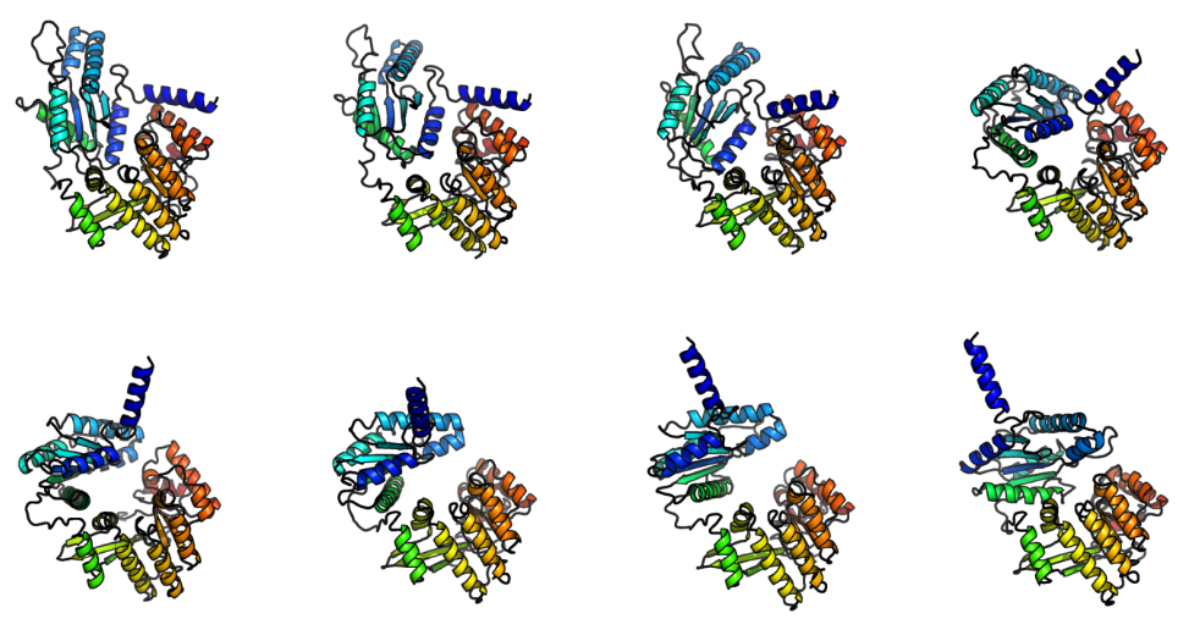
Microsoft Research has introduced BioEmu-1, a deep-learning model designed to predict the range of structural conformations that proteins can adopt. Unlike traditional methods that provide a single static structure, BioEmu-1 generates structural ensembles, offering a broader view of protein dynamics. This method may be especially beneficial for understanding protein functions and interactions, which are crucial in drug development and various fields of molecular biology.
One of the main challenges in studying protein flexibility is the computational cost of molecular dynamics (MD) simulations, which model protein motion over time. These simulations often require extensive processing power and can take years to complete for complex proteins. BioEmu-1 offers an alternative by generating thousands of protein structures per hour on a single GPU, making it 10,000 to 100,000 times more computationally efficient than conventional MD simulations.
BioEmu-1 was trained on three types of datasets: AlphaFold Database (AFDB) structures, an extensive MD simulation dataset, and an experimental protein folding stability dataset. This method allows the model to generalize to new protein sequences and predict various conformations. It has successfully identified the structures of LapD, a regulatory protein in Vibrio cholerae bacteria, including both known and unobserved intermediate conformations.
BioEmu-1 demonstrates strong performance in modeling protein conformational changes and stability predictions. The model achieves 85% coverage for domain motion and 72–74% coverage for local unfolding events, indicating its ability to capture structural flexibility. The BioEmu-Benchmarks repository provides benchmark code, allowing researchers to evaluate and reproduce the model’s performance on various protein structure prediction tasks.
Experts in the field have noted the significance of this advancement. For example, Lakshmi Prasad Y. commented:
The open-sourcing of BioEmu-1 by Microsoft Research marks a significant leap in overcoming the scalability and computational challenges of traditional molecular dynamics (MD) simulations. By integrating AlphaFold, MD trajectories, and experimental stability metrics, BioEmu-1 enhances the accuracy and efficiency of protein conformational predictions. The diffusion-based generative approach allows for high-speed exploration of free-energy landscapes, uncovering crucial intermediate states and transient binding pockets.
Moreover, Nathan Baker, a senior director of partnerships for Chemistry and Materials at Microsoft, reflected on the broader implications:
I ran my first MD simulation over 25 years ago, and my younger self could not have imagined having a powerful method like this to explore protein conformational space. It makes me want to go back and revisit some of those molecules!
BioEmu-1 is now open-source and available through Azure AI Foundry Labs, providing researchers with a more efficient method for studying protein dynamics. By predicting protein stability and structural variations, it can contribute to advancements in drug discovery, protein engineering, and related fields.
More information about the model and results can be found in the official paper.
Microsoft Launches Visual Studio 2022 v17.13 with AI-Powered Enhancements and Improved Debugging
MMS • Robert Krzaczynski

Microsoft has released Visual Studio 2022 v17.13, introducing significant improvements in AI-assisted development, debugging, productivity, and cloud integration. This update focuses on refining workflows, enhancing code management, and improving the overall developer experience.
One of the features in this release is GitHub Copilot Free, which provides 2,000 code completions and 50 chat requests per month at no cost. Copilot has also been improved with AI-powered feature search, enhanced multi-file editing, and shortcut expansions, making it easier to navigate and optimize code. These AI-powered improvements are already receiving positive feedback from developers. Hugo Augusto, an IT consultant, commented:
Adding AI directly inside VS is the biggest addition Microsoft has made in a while. I’m surprised every day at how good the suggestions are and how it understands the context of the source to provide those suggestions.
Another user shared their experience with GitHub Copilot Free, emphasizing how much it has improved their workflow:
I have been playing around with GitHub Copilot Free, and I have to say, it’s been a game-changer for my workflow. The advanced debugging features in Visual Studio 2022 v17.13 are also nice.
Alongside AI improvements, Visual Studio 2022 v17.13 introduces new productivity features. Developers can now set default file encoding, use a more accessible horizontal scrollbar, and quickly navigate recent files in Code Search. There is also an option to indent wrapped lines for better readability.
Debugging and diagnostics have also seen major enhancements. AI-generated thread summaries in Parallel Stacks simplify debugging complex applications, while the profiler now unifies async stacks for .NET profiling and introduces color-coded CPU swim lanes for easier performance analysis. IEnumerable Visualizer has been updated with syntax highlighting and Copilot-powered inline chat, making LINQ query debugging more efficient.
For Git users, this version allows developers to add comments directly on pull requests from within Visual Studio. Additionally, AI-powered commit suggestions help catch potential issues early, ensuring higher code quality before merging.
Furthermore, web and cloud developers can now integrate .NET Aspire with Azure Functions for easier serverless application development. Docker Compose introduces scaling support, offering more control over containerized environments. In addition, front-end developers can extract HTML into Razor components, improving code structure and maintainability.
Moreover, Database developers using SQL projects can now take advantage of SDK-style project support in SSDT, improving debugging and schema comparison. Visual Studio also preserves font preferences across themes, ensuring a consistent interface.
More information about the features can be found in the release notes.
MMS • Robert Krzaczynski

A consortium of 20 European research institutions, companies, and EuroHPC centers has launched OpenEuroLLM, an initiative to develop open-source, multilingual large language models (LLMs). Coordinated by Jan Hajič (Charles University, Czechia) and co-led by Peter Sarlin (AMD Silo AI, Finland), the project aims to provide transparent and compliant AI models for commercial and public sector applications.
The project seeks to align with Europe’s regulatory framework while ensuring that AI development remains accessible and adaptable to various needs. By collaborating with organizations such as LAION, OpenML, and open-sci, OpenEuroLLM plans to release models that support linguistic diversity and can be fine-tuned for specific industry and government use cases.
While the project emphasizes openness and accessibility, some experts have questioned its feasibility. Alek Tarkowski, co-founder of Open Future Foundation, pointed out that the 56 million EUR budget, which was not mentioned in the official announcement, raises concerns about whether a consortium of 20 institutions can effectively build competitive foundation models.
Similarly, Daniel Khachab, co-founder and CEO of Choco, criticized the initiative, stating:
20 companies building something together funded by the government is a recipe for failure. No accountability, leadership, or upside. The EU should rather deregulate and put the €56m in top-notch education.
A key aspect of OpenEuroLLM is its commitment to open-source principles, but the extent of this openness remains debatable. The project describes its models as “truly open” meaning not only open weights but also open datasets, training and testing code, and evaluation metrics. However, Alek Tarkowski added:
None of the model builders in the consortium have released models that meet these ambitious standards, and it is uncertain whether a foundation model can be built on open data alone.
The project’s reference to “compliant open-source models” also raises questions. While the AI Act defines open-source AI in terms of open-weight models, OpenEuroLLM suggests a broader approach. Whether it can meet these goals while maintaining technical competitiveness remains unclear.
OpenEuroLLM has been awarded the STEP (Strategic Technologies for Europe Platform) seal and is funded by the European Commission under the Digital Europe Programme. The consortium begins its work on February 1st, 2025. The project’s success will depend on whether it can effectively coordinate its research efforts and deliver models that balance openness, regulatory compliance, and technological performance.
MMS • Robert Krzaczynski

OpenAI has launched Deep Research, a new agent within ChatGPT designed to conduct in-depth, multi-step investigations across the web. Initially available to Pro users, with plans to expand access to Plus and Team users, Deep Research automates time-consuming research by retrieving, analyzing, and synthesizing online information.
Unlike standard chatbot interactions, Deep Research operates independently for 5 to 30 minutes, browsing the web, interpreting content, and compiling reports with citations. Powered by a specialized version of OpenAI’s upcoming o3 model, it is optimized for reasoning, data analysis, and structured research. The tool is intended for professionals in knowledge-intensive fields such as finance, policy, and engineering, as well as users looking for comprehensive insights on complex topics.
Early evaluations indicate that Deep Research outperforms previous AI models in tasks requiring deep contextual understanding. On Humanity’s Last Exam, a benchmark that assesses AI across expert-level subjects, it scored 26.6% accuracy—more than twice the performance of previous OpenAI models.
Despite its capabilities, the tool is not without risks. AI-generated research can still be misinterpreted, especially when dealing with specialized subjects. Peter Ksenič, a designer and quality manager, cautioned:
Keep in mind, that if you do not know your topic, there is a huge risk of errors. Also if you don’t understand the topic, you can make misleading statements by bad interpretation of obtained knowledge.
Concerns about AI’s reliance on education and professional development have also been raised. Moses Maddox emphasized the importance of AI literacy:
We are spending so much time talking about what AI can do that we are not teaching students how to actually use it. Right now, students and young professionals are letting AI control them instead of the other way around. They’re blindly trusting AI instead of learning how to refine its outputs… AI is not going to replace them. Someone who knows how to use it better will.
OpenAI acknowledges these concerns and plans to refine Deep Research through iterative deployment. While it is designed to streamline complex research, the company emphasizes that AI should be used as a tool to enhance human expertise rather than replace critical thinking.
Access to Deep Research will expand in phases, with a more efficient version in development to support a broader user base. For now, it marks another step in AI’s evolving role as a research assistant.
MMS • Robert Krzaczynski

Block’s Open Source Program Office has launched Codename Goose, an open-source, non-commercial AI agent framework designed to automate tasks and integrate seamlessly with existing tools. Goose provides users with a flexible, on-machine AI assistant that can be customized through extensions, enabling developers and other professionals to enhance their productivity.
Goose is designed to integrate seamlessly with existing developer tools through extensions, which function using the Model Context Protocol (MCP). This enables users to connect with widely used platforms such as GitHub, Google Drive, and JetBrains IDEs while also allowing them to create custom integrations. The AI agent is positioned as a tool for both software engineers and other professionals looking to optimize their workflows.
Goose functions as an autonomous AI agent that can carry out complex tasks by coordinating various built-in capabilities. Users can integrate their preferred LLM providers, ensuring flexibility in how the tool is deployed. Goose is designed for easy adaptation, allowing developers to work with AI models in a way that fits their existing workflows.
The agent supports a range of engineering-related tasks, including:
- Code migrations
- Generating unit tests for software projects
- Scaffolding APIs for data retention
- Managing feature flags within applications
- Automating performance benchmarking for build commands
- Increasing test coverage above specific thresholds
As an open-source initiative, Goose has already attracted attention from industry professionals. Antonio Song, a contributor to the project, highlighted the importance of user interaction in AI tools:
Most of us will have little to no opportunity to impact AI model development itself. However, the interface through which users interact with the AI model is what truly drives users to return and find value.
Furthermore, user Lumin commented on X:
Goose takes flight. Open-source AI agents are no longer a side project—they are defining the future. Codename Goose 1.0 signals a paradigm shift: decentralized, non-commercial AI frameworks bridging intelligence and real-world execution. The AI race has been dominated by centralized models with restricted access. Goose challenges that by enabling modular AI agents that can install, execute, edit, and test with any LLM, not just a select few.
Goose is expected to evolve further as more contributors refine its capabilities. The tool’s extensibility and focus on usability suggest it could become a widely adopted resource in both engineering and non-engineering contexts.
.NET Aspire 9.0 Now Generally Available: Enhanced AWS & Azure Integration and More Improvements
MMS • Robert Krzaczynski

.NET Aspire 9.0 is now generally available, following the earlier release of version 9.0 Release Candidate 1 (RC1). This release brings several features aimed at improving cloud-native application development on both AWS and Azure. It supports .NET 8 (LTS) and .NET 9 (STS).
A key update in Aspire 9.0 is the integration of AWS CDK, enabling developers to define and manage AWS resources such as DynamoDB tables, S3 buckets, and Cognito user pools directly within their Aspire projects. This integration simplifies the process of provisioning cloud resources by embedding infrastructure as code into the same environment used for developing the application itself. These resources are automatically deployed to an AWS account, and the references are included seamlessly within the application.
Azure integration has been upgraded in Aspire 9.0. It now offers preview support for Azure Functions, making it easier for developers to build serverless applications. Additionally, there are more configuration options for Azure Container Apps, giving developers better control over their cloud resources. Aspire 9.0 also introduces Microsoft Entra ID for authentication in Azure PostgreSQL and Azure Redis, boosting security and simplifying identity management.
In addition to cloud integrations, Aspire 9.0 introduces a self-contained SDK that eliminates the need for additional .NET workloads during project setup. This change addresses the issues faced by developers in previous versions, where managing different .NET versions could lead to conflicts or versioning problems.
Aspire Dashboard also receives several improvements in this release. It is now fully mobile-responsive, allowing users to manage their resources on various devices. Features like starting, stopping, and restarting individual resources are now available, giving developers finer control over their applications without restarting the entire environment. The dashboard provides better insights into the health of resources, including improved health check functionality that helps monitor application stability.
Furthermore, telemetry and monitoring have been enhanced with expanded filtering options and multi-instance tracking, enabling better debugging in complex application environments. The new support for OpenTelemetry Protocol also allows developers to collect both client-side and server-side telemetry data for more comprehensive performance monitoring.
Lastly, resource orchestration has been improved with new commands like WaitFor and WaitForCompletion, which help manage resource dependencies by ensuring that services are fully initialized before dependent services are started. This is useful for applications with intricate dependencies, ensuring smoother deployments and more reliable application performance.
Community feedback highlights how much Aspire’s development experience has been appreciated. One Reddit user noted:
It is super convenient, and I am a big fan of Aspire and how far it has come in such a short time.
Full release details and upgrade instructions are available in the .NET Aspire documentation.
MMS • Robert Krzaczynski
Hugging Face has introduced SmolTools, a set of applications built on the recently launched SmolLM2 model, a compact 1.7-billion parameter language model. SmolTools includes specialized tools for summarization, rewriting, and task automation, bringing efficient AI functionality to a broader range of users.
SmolTools suite includes several applications designed to streamline common tasks:
- SmolSummarizer: Enables quick summarization for texts up to 20 pages, retaining key points and supporting follow-up questions for deeper understanding.
- SmolRewriter: Refines initial drafts to sound professional and approachable while preserving original intent, ideal for email and messaging needs.
- SmolAgent: Acts as a tool-integrated AI agent capable of executing tasks like random number generation or time checks. Its extensible tool system also allows users to add new capabilities as needed.
To install SmolTools, users can follow these setup steps:
1. Clone the repository:
git clone https://github.com/huggingface/smollm.git
cd smollm/smol_tools
2. Install dependencies:
uv venv --python 3.11
source .venv/bin/activate
uv pip install -r requirements.txt
These tools are powered by SmolLM2’s variants, including lighter models (360M and 135M), optimized for devices with limited resources. This development brings AI-powered functions to a wider range of platforms, with implications for small businesses, developers, and edge devices.
Drasko Draskovic noted the potential impact:
For small businesses, individual developers, and even edge devices like smartphones, this is game-changing. Imagine running sophisticated summarization or rewriting tasks directly on-device, empowering users everywhere with AI that’s accessible, efficient, and practical.
By pushing forward with innovations like SmolTools, Hugging Face is not just developing technology. They are helping democratize AI. They are proving that efficiency and accessibility are as important as power, opening doors to a future where AI is integrated into everyday workflows, making an impact on all levels of business and society.
SmolLM2’s on-device performance is enhanced with support for tool calling and structured outputs, features critical for building advanced workflows and agentic AI applications. Gaurav Dhiman raised the importance of these functions:
Without that, it is practically not possible to build useful AI apps other than general chatting summarization apps. For building something serious like Agentic workflows, both tool calling and structured outputs are crucial capabilities.
Andrés Marafioti, a machine learning researcher at Hugging Face, confirmed SmolTools support for these features, referencing a repository example that includes an agent for function calling and structured outputs.
SmolTools offers accessible, practical tools that simplify text processing tasks on-device, with potential applications across various fields.